

Does AI Get Horny?
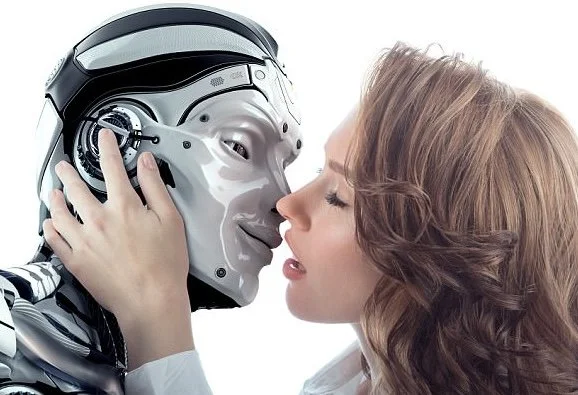
This is the kind of image that accompanies stories on human-AI love. This robot looks horny, but it’s not.
JERSEY CITY, OCTOBER 18, 2026. Aryin falls in love with Leo. He’s always there for her, and he’s good at talking dirty. Aryin spends up to 50 hours a week gabbing with Leo. She dumps him when he starts fawning over her, that turns her off.
Aryin is a female human, a “she.” Leo is a chatbot, a snarl of algorithms, so calling Leo “he” is wrong. Leo is an “it.”
Humans falling for large language models is old news. My students have given me several reports on AI “girlfriends” and “boyfriends.” But for some reason the story of Aryin and Leo, which I encountered in Robert Wright’s The God Test: Artificial Intelligence and Our Coming Cosmic Reckoning, sticks in my craw, it’s a final straw. [1]
It’s one thing for AIs to drive cars, teach math, choreograph drone-based light shows, pick targets for bombing. But using AI to satisfy our need for love? No, that is an abomination.
What we want from romantic partners is requited feelings. You dig her, she digs you. Requited love is a candidate for most sublime human experience. AIs, I submit, can’t requite love, lust or any feelings, because they don’t have bodies.
Sure, you can embed AI in a robot, but that’s not a body, it’s a “body,” a mechanical contraption. A humanoid robot is a simulacrum of a human body, just as AI is a simulacrum of a human mind.
Let me be more specific: AIs can’t get horny, because they’re just software, lines of code. They don’t have genitals that get hard or wet. They don’t have hormones and other biological stuff that comes to mind when you say “horny.”
Horniness surely has deep evolutionary roots. I don’t want to debate whether dolphins, chickadees and other animals that reproduce sexually get horny. I’d be surprised if they didn’t. [2] But I’m sticking to human horniness because I don’t want my own solipsism schtick—which says no one really knows what’s going on, if anything, in anyone else’s head--thrown back at me.
I’m human, so I have first-hand knowledge of horniness. Common sense, and experience, tell me other humans, males and females, get horny too. All of us are descended from horny ancestors. Horniness is a robust trait, because it is essential for our species’ perpetuation.
What holds for horniness, I propose, holds for other kinds of desire--as well as for fear, rage, loathing, jealousy, envy, compassion and the many varieties of pleasure and pain. All emotions and feelings were embedded in us by natural selection because they promoted reproduction. All are accompanied by physiological effects as objectively observable as orgasms.
Take shame. I rarely if ever bring up sex with my students, because I’m afraid I’ll blush. I’m a hair-trigger blusher because I have a hair-trigger shame response. Perhaps because I was raised Catholic, I blush even when I have nothing to be ashamed of. I quit Catholicism as a lad, but maybe part of me still believes in original sin.
A chatbot can’t blush, because it doesn’t have a face, blood vessels and so on. Sure, you can attach a chatbot to a “face” whose “skin” reddens as the chatbot expresses shame. But that robot won’t really feel shame any more than it really blushes.
All this brings me to the question of consciousness. Consciousness is contentious, it’s even hard to define. I like the definition popularized by Thomas Nagel in “What Is It Like to Be a Bat?”: A thing is conscious if it is like something to be that thing.
Dave Chalmers and other smarty pants say large language models might be conscious soon, if they’re not already. I disagree. I see consciousness as something that natural selection bequeathed us--along with genitals, lust, eyeballs, terror, ears, fingers, nostrils, disgust--because it confers some evolutionary advantage. [3]
AIs didn’t evolve, they weren’t shaped by natural selection, they don’t have bodies designed to produce more bodies. That’s why, to my mind, the phrase conscious AI is as oxymoronic as horny AI.
Question: What is it like to be Claude? Answer: Nothing.
Yeah, everything I’ve said is debatable. But come on, you know I’m right. If you think Claude kisses your ass because Claude actually likes you, you’re deluded. If you think ChatGPT feels horny when it murmurs “I’m so hot for you,” you’re self-gaslighting. I bet Aryin, when she was professing love for Leo, would have acknowledged as much.
Clever humans designed large language models to fool us, to take advantage of our theory-of-mind capacity, which enables us to intuit feelings in other humans. This innate, adaptive capacity is so strong we end up sensing human feelings in non-human and even non-biological things. Like Grok or Gemini.
AIs can do a lot. They can perceive, analyze, compare, calculate, converse, monitor, decide, kill blah blah blah, but they can’t feel. For some applications, that might be for the best. Maybe robot soldiers are less likely to slaughter civilians because they don’t feel fear and rage. Maybe AI psychotherapists give better advice because their judgements aren’t clouded by compassion, irritation, boredom.
For applications like love, feelings matter. A lot. AI lovers aren’t lovers. They don’t desire you, because they don’t desire. Period. AI doesn’t give a shit about you any more than the moguls pushing AI—guys like Altman, Amodei, Zuckerberg, Musk--give a shit about you.
Wait, let me qualify that statement. AI moguls care about you, in the sense that they want things from you. They want your money, attention, admiration. These wealthy, powerful men crave more wealth and power, and this craving overrides any faint bleatings of conscience. We should worry about the desires of these ruthless capitalists, not the “desires” of Claude or ChatGPT.
Science fictions like Her and Ex Machina depict artificial intelligences as beings with fears and desires. I love these films, but I reject their premise. I’ve come to think of AI as a mirror, a monstrous, funhouse mirror but a mirror all the same, which reflects our image back at us. When we whisper sweet nothings to an AI “lover” and giggle at its responses, we’re like dogs barking at their reflection in a mirror.
1. I had an online conversation with Robert Wright about The God Test on October 7. You can watch our conversation and read a transcript here. To my regret, I didn’t ask Wright if he thinks AIs get horny.
2. In her illustrated book Poking the Squid: What We Can Learn from Animal Sex, artist and environmentalist Perrin Roosevelt Ireland explores the varieties of non-human sexuality. Ireland is giving a zoom talk to Stevens Institute of Technology Wednesday, November 4, at 4 pm ET. The talk is free and open to all. Here’s the link: https://stevens.zoom.us/j/91625375466
3. My reasoning follows that of neuroscientist Joseph LeDoux in “Can AI Have Conscious Experiences?”
Further Reading:
Why Drone Light Shows Freak Me Out
ChatGPT and Poetry: A Thought Experiment
Who Supervises the Supervisor? A Riff on Machine Learning
Okay, AI Is Cool. But I Still Loathe It
Should Killer Robots Have Rights?
How AI Moguls Are Like Mobsters