

Why Drone Light Shows Freak Me Out
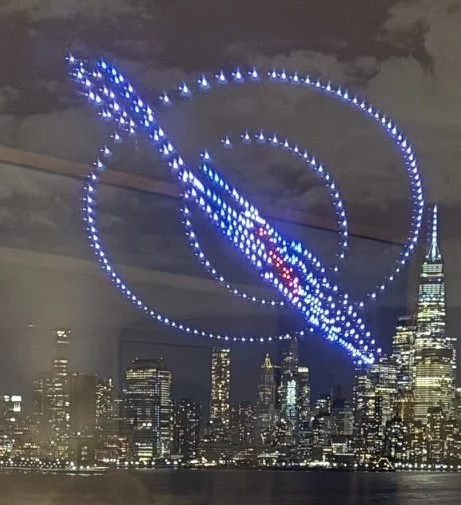
Drone light show I photographed from my apartment. Cool, right? But think of the bad things you can do with AI-enabled drones.
HOBOKEN, SEPTEMBER 19, 2026. To mark the 25th anniversary of the September 11 attacks, 2,977 drones, one for each person killed, flew into the sky over Manhattan and formed outlines of the Twin Towers.
I missed that show. But last night, as I sprawled on my couch watching an old Star Trek: Next Generation episode, something outside my window caught my eye. A swarm of lights rose from Pier A, which juts out from the Hoboken waterfront, and assembled over the Hudson River. The lights were bright white at first then kept changing colors.
The lights formed a helicopter with a rotating propeller. They also spelled out images I couldn’t recognize and words I couldn’t read, because the angle wasn’t right. And they mimicked fireworks.
The show lasted 20 minutes or so. I couldn’t find anything about it online. I’m guessing it had a commercial purpose. The show dazzled me. And terrified me.
Artificial intelligence enables these drone displays. Read this technical paper on AI that lets you choreograph drones with “standard commercial hardware.” You tell the AI what you want the drones to do, in the form of a text prompt. The AI carries out your wishes, choreographing the drones’ movements. You imagine the drones doing something, and AI makes it happen.
Drone light shows are provoking oos and ahhs all over the world. Check out this video of a show in China in February in which more than 22,000 drones form complex, gorgeous, three-dimensional images
Here’s why these drone shows freak me out: In 2013 I wrote an investigative report for National Geographic, “The Drones Come Home,” about the adoption of military drones by U.S. law enforcement. I presented highlights of that article in a 2013 column for Scientific American titled “Why Drones Should Make You Afraid. Very Afraid.” Here are excerpts, lightly edited:
*The Obama administration was trying to relax Federal Aviation Administration restrictions to make it easier for U.S. law-enforcement agencies to deploy drones for surveillance and other uses. According to The New York Times, the Department of Homeland Security was helping police departments purchase drones, which are "becoming a darling of law-enforcement authorities across the country.”
*The Obama regime quietly compiled legal arguments for assassinations of American citizens without a trial, according to NBC News. The administration carried out extrajudicial drone assassinations of at least two American citizens, the alleged Muslim militants Anwar al-Awlaki and Samir Khan, who were killed in Yemen in 2011.
*The U.S. military had already deployed a drone, called “Switchblade,” that had foldable wings and could be packed into a tube not much bigger than a loaf of Italian bread. Switchblade packs a grenade-size charge. I got to handle one of these lethal gadgets.
*The Defense Advanced Research Projects Agency was funding research on even smaller “micro-drones” that resemble moths, hummingbirds and other small flying creatures and hence can "hide in plain sight," as one Air Force researcher told me. The Air Force was testing micro-drones at facilities such as the “micro-aviary” at Wright-Patterson Air Force Base in Dayton, Ohio, which I visited.
*The U.S. enthusiasm for drones triggered an international arms race. More than 50 other nations possessed drones, as well as non-governmental militant groups such as Hezbollah. U.S. security officials were so worried about the threat of drone terrorism that they carried out mock attacks in a program named "Black Dart." Defense contractors were developing software that enabled drones to track and destroy other drones.
That was all happening 13 years ago. Obama was President. Imagine the state of AI-enabled drones today. When I see drone light shows now, I recall an extraordinarily creepy animated video the Air Force showed me back in 2012..
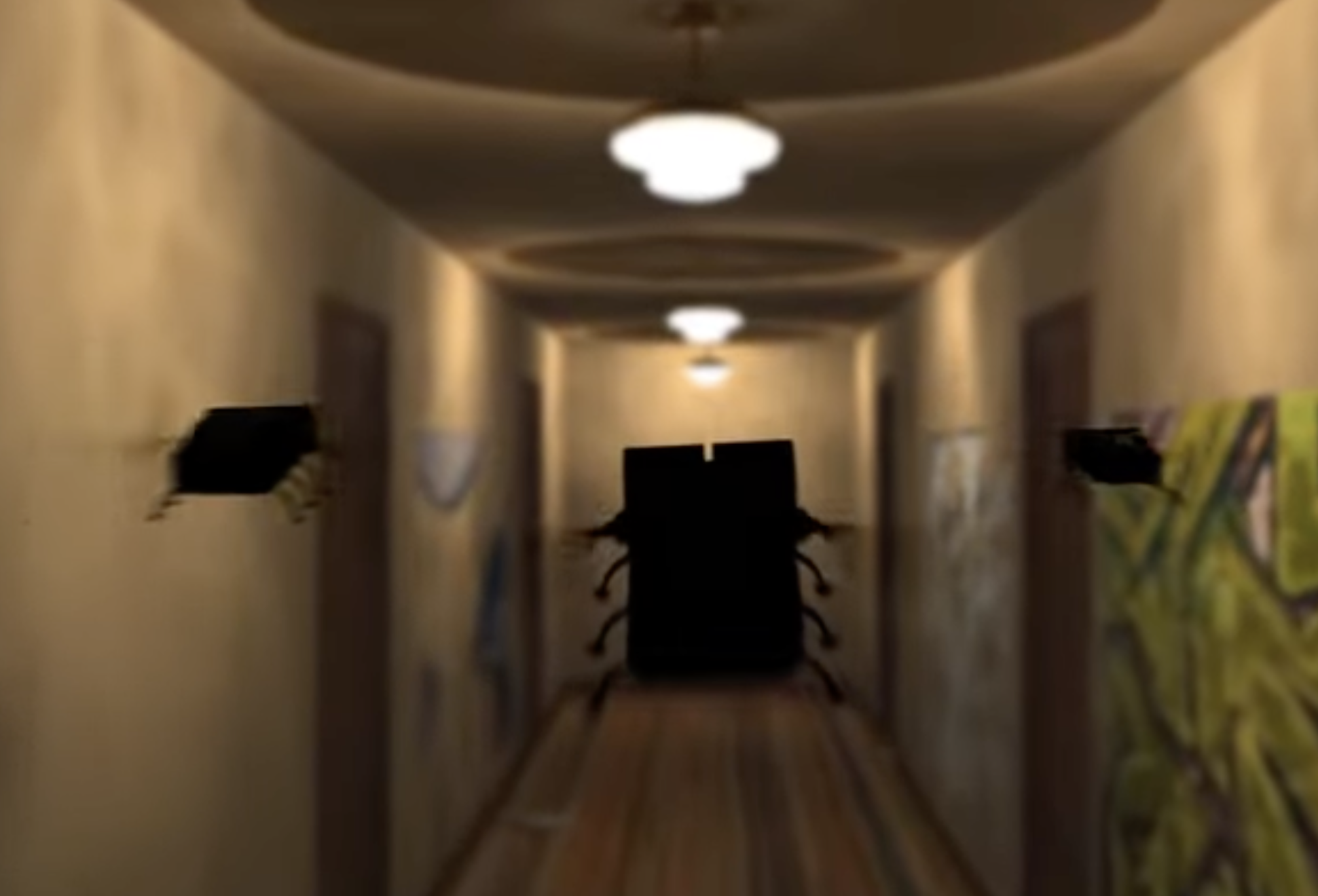
“Micro-air vehicles” look for someone to kill in a video the Air Force showed me in 2012. Creepy, right?
The video predicts that “micro-air vehicles, or MAVs, will play an important role in future warfare.” The narrator calls MAVs "unobtrusive, pervasive, lethal." The video shows these drones, which look like cell phone with wings, swarming out of the belly of a plane and descending on a city.
The drones can carry out surveillance, the narrator says, and they can be “equipped with incapacitating chemicals, combustible payloads or even explosives for precision targeting.” The video shows a drone flying into a building and shooting a gunman in the back of the head.
In 2013, swarms of killer drones seemed sci-fi-ish. Now, not so much. Last night, as I watched those AI-controlled drones whizzing back and forth over the Hudson, I imagined them fanning out through New York City and Hoboken spying on and killing people.
Oh, by the way, in the Star Trek episode I watched last night, Data, the android, who’s usually sweet, suffers a brain glitch and becomes a killer. Appropriate, eh?
Further Reading:
Okay, AI Is Cool. But I Still Loathe It
An AI-Hater Tries to Learn the Math That Underlies AI
An AI Critic Talks to a Tech School