

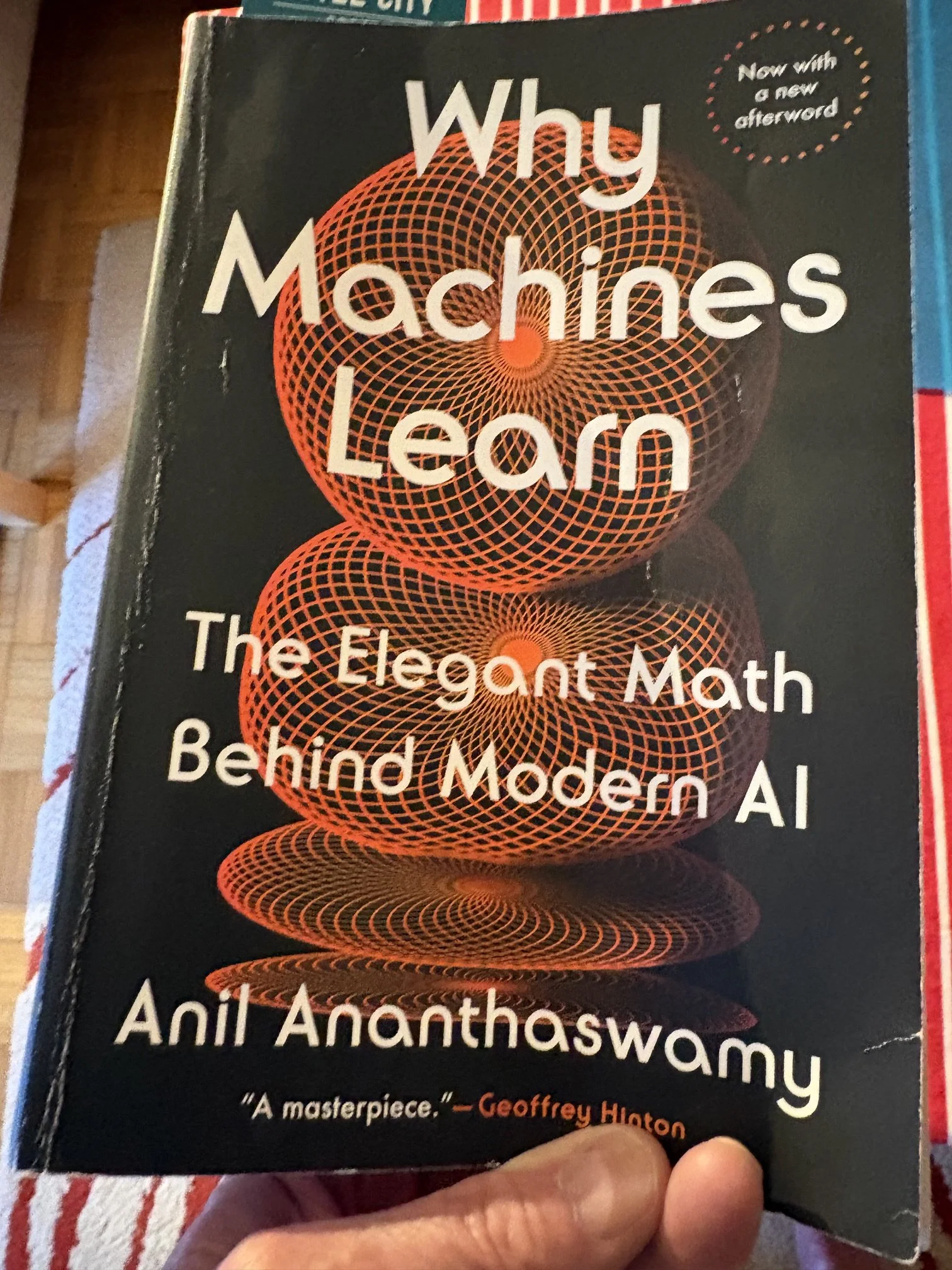
I’m hoping this book will help me learn how machines learn.
HOBOKEN, JUNE 24, 2026. I think I’ve solved my AI dilemma.
On the one hand: The ongoing explosion of AI is the biggest science story of my career. What’s bigger? The Bomb? Climate change? You can avert your gaze from those threats, but AI is inescapable. It has wheedled its way into our offices, classrooms, cars, homes, heads. It’s my duty, as a science journalist, to report on AI.
On the other hand: I loathe AI, for reasons I’ve spelled out here, here and here. When friends rave about the brilliance of Claude or ChatGPT or whatever, I get depressed. I fear they’re becoming zombies, pod people, their brains devoured by digital parasites.
I want to know how chatbots work, if only to demystify them, but I don’t want to chat with them. That’s the dilemma. So what’s my solution? Instead of talking to the black box, I’m lifting its lid and peering inside. I hope to learn the math that underpins machine learning, the key to AI’s power, without asking AI for help.
I’m proud of this solution, it makes me feel like Perseus. He’s the Greek hero who fought Medusa, the snake-haired monster who turned everyone who looked at her into stone. Perseus managed to decapitate Medusa while looking at her reflection in his shield.
It’s not a perfect analogy—it would be better if everyone who listened to Medusa turned into stone--but you get the idea. Another difference between Perseus and me is that I just want to understand the monster, not kill it. AI can at best be controlled, its risks minimized, but it’s here to stay.
(Unless of course AI precipitates a Gibsonian “Jackpot” that annihilates civilization. I imagine our illiterate hunter-gatherer descendants, roaming the veldt a thousand years hence, pausing in wonderment before a colossal wreck bearing the mystic runes “Amazon Web Services Data Center.”)
Pod people say you shouldn’t knock AI unless you try it, that is, talk to it. The implication is that bashing AI while refusing to use it makes you anti-scientific. You’re like those guys who refused to look through Galileo’s telescope because they refused to believe Jupiter could have moons.
I prefer this analogy: Writing about the dangers of AI without using AI is like writing about the opioid-addiction crisis without trying opioids. Shooting up heroin might give me insights into addicts’ craving, but what if I get hooked? Like smartphones, social media and all digital technologies, chatbots are designed to be addictive, and they are cheaper and more accessible than heroin.
I can hear podsters sputtering, But, but, but… But AI has discovered things even more astounding than the moons of Jupiter! AI is solving problems in math and biology and physics and has found promising possible treatments for cancer and lots of other amazing stuff!
My response: Maybe AI helps a few good scientists discover a few things they wouldn’t have otherwise, but it also helps fools and frauds spew bullshit at an accelerating rate.
Hypothesis: If signals increase linearly and noise exponentially, signals inevitably become undetectable. If we haven’t reached that point yet, we will soon.
Do I suffer from AI Derangement Syndrome? Perhaps. But my antipathy to AI, my gut feeling that it’s bad, gives me protection from AI infection as I learn how machines learn. I can indulge in my curiosity about AI—and fulfill my responsibility as a science writer—without becoming a pod person. That’s the plan, anyway.
My first step is to contact Dean and Luis, my classmates in a quantum-mechanics course I took in 2020 at Stevens Institute of Technology. Dean and Luis, who have degrees in computer science and physics, respectively, were my study buddies. They tutored me in quantum math, as I recount in my 2023 memoir My Quantum Experiment. I email Dean and Luis:
“I'm thinking of trying to learn the math underlying machine learning as a way to deal with my anxieties about AI. So I’m wondering: What math is essential for machine learning, and how might I go about learning it? Do you guys have any suggestions?”
Dean, who has worked as a subcontractor for Google and Anthropic, replies that “the math behind AI is much more approachable than that of quantum physics. Not sure how far down this rabbit hole you’ve gotten already, but after a few key takeaways, I’m sure you’ll find your anxieties properly corroborated.”
Dean recommends videos on linear algebra and neural networks by the superb math explainer 3blue1brown. Luis, an optics whiz who has worked for NASA, adds, “If you ever want to go over some linear algebra stuff, I am more than happy to help and make time for you.” Luis “reminds” me:
Vector1 = (x1,y1,z1) & Vector2 = (x2,y2,z2).
Dot product: Vector1 = Vector2 = x1x2+y1y2+z1z2 = number (scalar).
Yeah, bring on the dot products, baby! I love my study buddies!
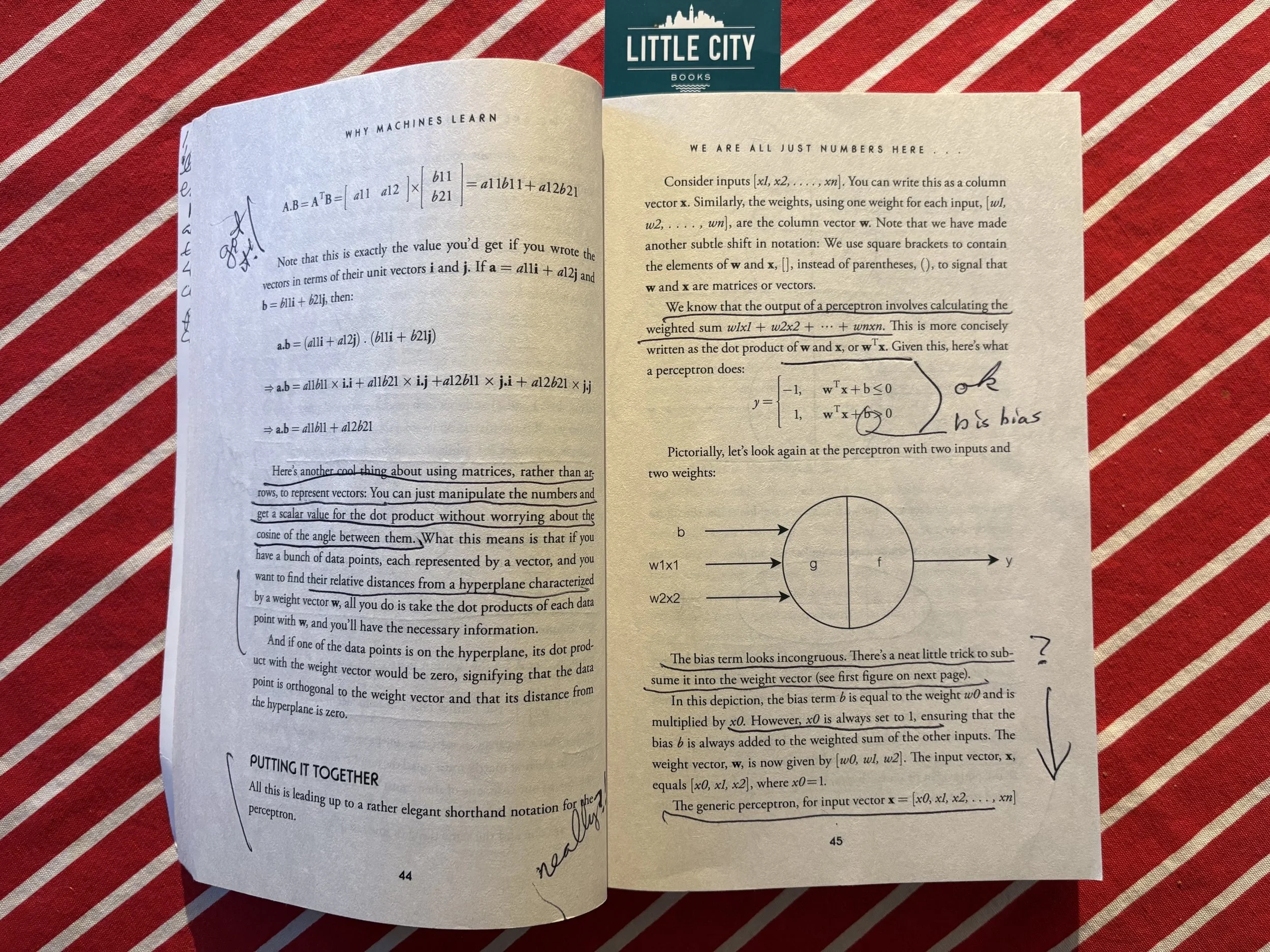
Pages from Why Machines Learn, with my scribbles.
I also email George Musser, a friend and physics journalist. He’s the author of Putting Ourselves Back in the Equation, an in-depth report on how “Physicists Are Studying Human Consciousness and AI to Unravel the Secrets of the Universe,” as the subtitle puts it. George recommends Why Machines Learn: The Elegant Math Behind Modern AI by Anil Ananthaswamy, a software engineer turned science journalist. George warns that the book, published in 2024 and with a new afterword last year, might soon be dated.
I order Why Machines Learn, 2025 edition, from Amazon (yeah, I know), get it the next day, jump right in. Ananthaswamy promises to explain how “relatively simple” math enables computers to “discern patterns in data without being explicitly programmed to do so.” The math includes “linear algebra, calculus, probability and statistics, and optimization theory.”
This list doesn’t daunt me as much as you might expect. I studied linear algebra (vectors, matrices, dot products) and calculus (limits, derivatives, integrals) for my recent quantum project. I’m not starting this AI project from scratch.
One final point, or confession: Above I say the “first step” of my project was reaching out to Dean and Luis. Humans. That’s a lie. My first step was googling “math for AI.” Google’s “AI Overview” tells me that AI is based on linear algebra, calculus and probability, and it links to a helpful discussion on reddit.
I didn’t ask Google for an AI Overview, but I haven’t tried to shut this function down, either. My plan is to learn how AI works without AI’s help, but I might slip now and then. The AI is always there, watching me, waiting for a sign of weakness. If I start raving about how cool Grok is, you’ll know what happened.
Okay, back to Why Machines Learn. What’s a dot product again?
COMMENTS ON FACEBOOK: This column has provoked responses on my Facebook feed from Steve Sagona (my former student, who got a PhD in physics and helped me with my quantum project) and others. See https://www.facebook.com/john.horgan.79
Further Reading:
An AI Critic Talks to a Tech School
How AI Moguls Are Like Mobsters