

Tolstoy’s “Resurrection” and the Lucky Man’s Dilemma
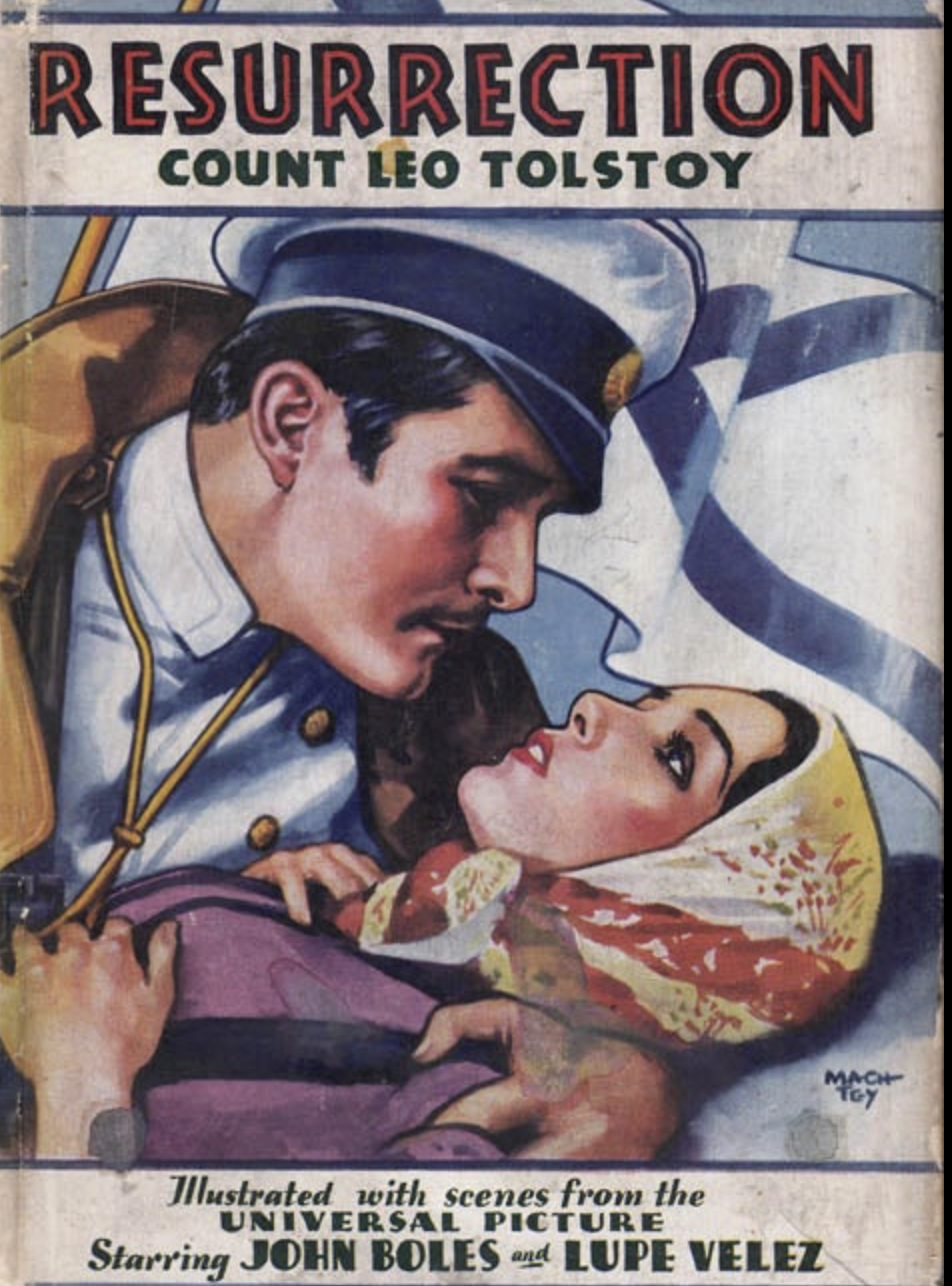
This 1931 edition of Resurrection doesn’t really capture the novel’s dark, unsexy vibe.
HOBOKEN, JUNE 20, 2026. A novel written in late 19th-century Russia has me mulling over my moral obligations in 21st-century America. The novel is Tolstoy’s Resurrection.
I love Tolstoy’s masterpieces Anna Karenina and War & Peace (see my review of the latter here). Is any narrator more omniscient than Tolstoy? Wiser? He seems not only to know but to understand everything about everything.
Resurrection is Tolstoy’s last full-length novel. After finishing it in 1899, he spent the last decade of his life espousing a radical Christian message: we should love each other and renounce violence and ownership of private property.
I resisted reading Resurrection because I heard it’s preachy, a fictionalized sermon. And the novel, to be sure, is relentlessly serious. It makes War & Peace, not exactly light reading, seem escapist. But Resurrection is just as gripping and profound. It’s a masterpiece, too.
In the earlier novels, Tolstoy scans the vast panorama of human existence, the good and the bad. Resurrection dwells on the bad, on injustice and misery. The novel is a page turner, you’re eager to see what happens next, but it’s disturbing, it makes you squirm. You sense Tolstoy glaring at you, demanding a response: What are you going to do about this?
Here’s the novel’s setup: A thirty-something aristocrat, Dmitri Nekhlyudov, who has recently left military service and feels a bit adrift, serves on a jury in a criminal case. One defendant, Katyusha Maslova, is a prostitute accused of poisoning and stealing from a client.
Dmitri recognizes Katyusha, who was once a servant on his aunts’ estate. Ten years earlier, while visiting his aunts, Dmitri seduced Katyusha, a virgin. Then he headed back to his regiment, where he resumed his carefree, dissolute life.
Katyusha suffered the consequences of the dalliance. When she became visibly pregnant, Dmitri’s aunts banished her from their property. Katyusha’s baby died after she gave birth, because she couldn’t care for it properly. Depressed, destitute, lacking relatives to take her in, she became a prostitute.
In court, Katyusha admits she drugged her client but insists she meant to knock him out, not kill him. She’s not exactly innocent, but Dmitri condemns himself, not her. Everything that’s happened to Katyusha is his fault. He must make amends, but how? What should he do?
This plot summary probably makes Resurrection sound like a parable: a sinner seeks redemption. It’s like a Russian Lord Jim, except the sin is lust, not cowardice. But Tolstoy’s work is far more powerful than Conrad’s, because Resurrection explores—in hyper-realistic, documentary detail--the flaws not of one atypical man of but of an entire all-too-typical society.
The jury believes Katyusha didn’t mean to murder her client but convicts her anyway, and the judge sentences her to four years hard labor in Siberia. Aghast, Dmitri hires lawyers to appeal Katyusha’s conviction and asks friends in high places for help.
Dmitri also visits Katyusha in prison and begs her to marry him. When she recognizes him, she angrily, proudly refuses his proposal. Dmitri keeps visiting her anyway and seeking her release. When his efforts fail, he follows her and other convicts as guards herd them across Russia to Siberia.
His sympathies aroused by Katyusha, Dmitri becomes absorbed by the plight of other prisoners, too. He tries to help those who are common criminals, like Katyusha, as well as political prisoners jailed for opposing the Russian regime. Resurrection eerily foreshadows the catastrophic Soviet revolution, during which fanatical do-gooders smashed one unjust regime and erected another.
Dmitri’s saga gives Tolstoy an excuse to take us deep inside Russia’s criminal-justice system. He exposes the laziness, incompetence and casual corruption of judges, prison guards, wardens, defense attorneys, prosecutors, politicians.
We see the boundless vanity and capacity for self-delusion of Dmitri’s rich, complacent friends and relatives. They think he’s a holier-than-thou poseur or a fool. They say, Maybe the system isn’t fair, but there’s nothing you can do about it, you’re throwing your life away for a whore.
The characters all seem absolutely real, especially Dmitri. He’s overcome by epiphanies in which he realizes—he knows!--that love must guide all human relations. But when he tries to act on this principle, he second-guesses himself: Does he actually give a shit about Katyusha, or is his do-gooding mere self-glorification?
Circumstances thwart his efforts to do the right thing. Ashamed of his unearned wealth, he tries to give land to the peasants who work it. The peasants assume he’s trying to trick them and refuse his offer.
Dmitri agonizes over whether giving his property away will hurt his sister’s family. And if he loses all his income, how can he help others? (Tolstoy struggled with these dilemmas toward the end of his life, as dramatized in the 2009 film The Last Station.) Dmitri struggles to love those who despise him, like his sister’s husband, a smug bureaucrat.
What does Dmitri’s world, you might ask, have in common with ours? With life in the era of large language models and space travel? Well, it’s all still there, the injustice and misery, if you bother to pay attention. I saw it during my recent trip to India. I see it in Hoboken, my hometown, and New York City. It’s there when I read the news. And the elites are richer and more arrogant than ever.
Resurrection reminds me of HBO’s superb series The Wire, which starts as a crime drama and ends up analyzing the varieties of dysfunction plaguing Baltimore. One difference is that race, more than class, divides the people of Baltimore. And The Wire doesn’t demand a moral response from us as urgently as Resurrection does.
Tolstoy conveys, almost too vividly, the horror and disorientation a lucky man feels confronting others’ unluckiness. Tolstoy shows the ways in which the fortunate avoid dwelling on others’ misfortune. We look away, we rationalize: That’s just the way things are, some are lucky, some aren’t.
We tell ourselves things are getting better, as Steven Pinker and other apologists assure us. Sure, some poor souls are still punished unfairly, but for the most part people get what they deserve. And what can one person do, anyway? Be grateful you’re lucky.
Further Reading:
India and the Unfairness Problem
Free Will, War and the Tolstoy Paradox
Things Were Worse When I Was Young
For more of my thoughts on social progress, see Chapter Nine of my book Mind-Body Problems: “A Pretty Good Utopia.”