

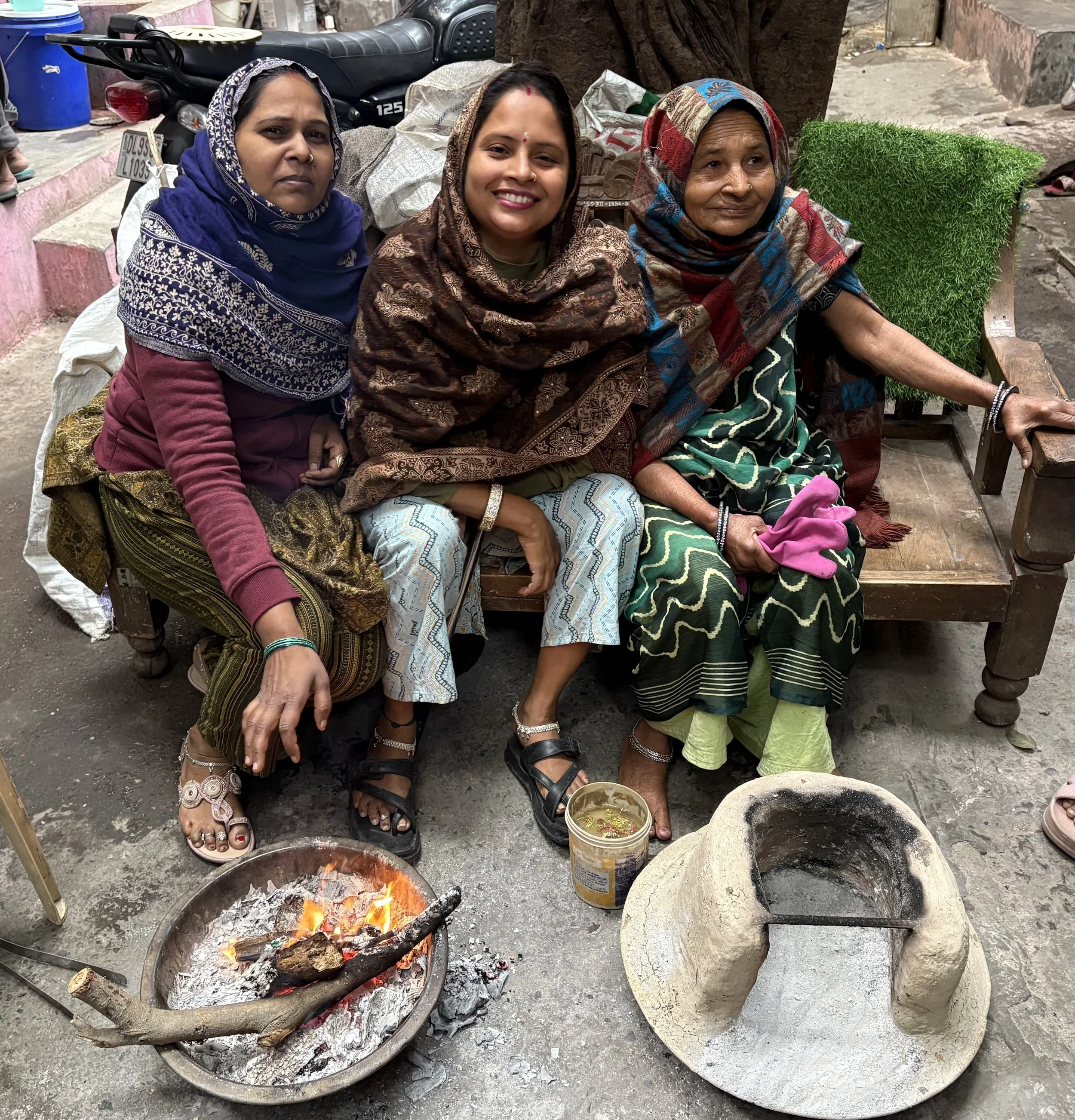
I met these women in Delhi while touring a “slum,” the term for an area where people squat in “unauthorized” dwellings.
HOBOKEN, JAN. 12, 2026. I’m a white American male born to loving parents who could afford to send me and my four siblings to college and graduate school. This makes me luckier than the vast majority of people living and dead.
I’m not gloating. If anything, my good fortune, which I did nothing to deserve, embarrasses me. It’s not fair that I have so much while others, through no fault of their own, have so little.
It’s easy to forget the unfairness problem when I’m here in New Jersey listening to my students, hanging with my kids and friends, watching Pluribus. Yes, when I jog along the Hudson River, I pass a few men and women sleeping on benches. But otherwise you don’t encounter extremes of misery and wealth in Hoboken.
In India, where I recently traveled to attend a wedding, unfairness smacks you in the face. I spent my first five days sightseeing in and around Delhi. I had the same ambivalent response to the Taj Mahal, a humongous tomb built by an emperor for his favorite wife, that I had to the Sistine Chapel: Wow, what a stunning testament to human artistry! And to the boundless vanity and self-glorification of the 0.000001 percent.
I flew from Delhi to Kolkata for the multi-day wedding and checked into the Taj Bengal hotel. After I passed through the metal detector into the hotel’s immense, opulent lobby, two smiling young women in scarlet and gold saris greeted me. One wafted incense under my nose, murmuring that it confers good luck. Yeah, more luck, just what people staying in this palace need.
The other woman handed me a goblet brimming with an ambrosial and no-doubt health-enhancing beverage. Meanwhile across the lobby four tuxedoed men, a string quartet, tickled my ears with some delightful classical concoction.
So I stayed in a posh hotel. What’s my point? Well, the cab ride to the Taj Bengal took me past clusters of women, toddlers and infants huddled under blankets on the side of the road, inches from rushing, beeping cars, buses, trucks, tuk-tuks, scooters. I’d been warned about this poverty, but seeing it first-hand shocked me.
An incident back in Delhi exacerbated my cognitive dissonance. There I met Seema, an Indian-born, U.S.-educated mathematician who oversees Leora Trust, an organization she founded in 2012. Funded by donations from family and friends, the nonprofit works to support education and nutrition of girls in a Delhi “slum.”
Slum is Seema’s term for a district where people have squatted on “unauthorized” land and built unauthorized homes over the years. No one owns land in a slum, no one pays rent. Over the years various politicians have provided a few basic services: a communal bathroom, electricity, water for drinking and washing at fixed collection points.
Homes typically accommodate four to six family members in 70 square feet of space, Seema told me. Slum-dwellers are usually employed, if at all, as domestic workers in surrounding upper-middle-class homes. These jobs are low-paying and precarious; they can be easily lost.
Seema gave me a tour of the slum. As we walked through narrow alleyways lined with ramshackle shops and dwellings, Seema introduced me to women, children and men, and I learned a little about each: This man has a degree in political science. He and his wife recently lost their teenage son to cancer.
21-year-old Amisha, who accompanied us on the tour, is a trained civil draughtsman and hopes to be a civil engineer. She cannot afford to buy a smartphone or laptop, though she needs both for her work.
Again, so what? Well, I have a tendency to label certain people I pass on the streets—whether in Hoboken or Delhi—as “poor” or “homeless.” I don’t see them as individuals. Just as neurologist Oliver Sacks reminds us not to reduce patients to pathologies, so Seema’s guided tour reminded me not to reduce the poor to their poverty.
Every single one of India’s billion-plus citizens, even the most wretched, is a once-in-eternity human being wrestling with her own unique mind-body problems. This easily forgotten truism makes the unfairness problem even more excruciating.
For most of human history, unfairness wasn’t a problem, it was just the natural order of things. Fate or God or whatever decrees that some have good luck, others bad. Most people have bad luck. Life is nasty, brutish and short, that’s the way things are.
India gave rise to two religions, Hinduism and its offshoot Buddhism, that aim at getting us to accept the unfairness problem. Both propose that this painful, unjust, material world is an illusion. Both espouse the doctrine of reincarnation; if you get a bad deal in this life, you might do better in the next.
Hinduism and Buddhism also prescribe practices, such as yoga and meditation, that can help us attain moksha, which means awakening or liberation. I imagine moksha as blissful indifference to your material circumstances, whatever they might be.
Christianity addresses the unfairness problem even more explicitly. Jesus assured the poor that they are more likely than the rich to make it to heaven after they die. Wouldn’t it be nice to think so.
Only within the last few centuries have various do-gooders insisted that unfairness isn’t something to accept; it’s a problem we can and must solve. Marx, who rejected religion’s consolations, laid out a detailed scheme for eliminating unfairness.
I’m not a Marxist, but I am a woke, bleeding-heart liberal, who thinks government’s chief function should be reducing the unfairness problem. Government efforts to help the unlucky have worked pretty well. Extreme poverty has declined both here in the U.S. and worldwide over the past century or two. Yeah, I buy those Pinker-esque statistics. [See Addendum.]
But there’s pushback now, in the U.S., India and elsewhere, against the idea that unfairness is a problem. The current U.S. administration has slashed programs to help the poor. Businessmen-turned-right-wing politicians, Silicon Valley libertarians and other lucky assholes are telling the unlucky: Yeah, life’s unfair, tough shit, deal with it, loser, your bad luck ain’t my problem.
Or words to that effect. This atavistic trend, this reversion of elites to a cruel social Darwinism, strikes me as a threat to what currently passes for civilization.
One final point. Before my trip to India, a friend who’d traveled there gave me the old line about how India’s poor seem happy. Money isn’t everything, man!
Maybe there’s some truth to this sentiment. I observed smiles and laughter on my walk through the Delhi slum. And sure, rich people can be miserable, and even billionaires get old and die (at least until they find a cure for mortality).
But it strikes me as immoral, even grotesque, for the affluent to say the poor are happy--or would be if they accepted their lot with Zen equanimity. Those of us who are lucky have a duty to help the unlucky. We might start by electing leaders who give a shit about the unfairness problem instead of dismissing it as the natural order of things.
Addendum: In “Hype and Fraud in India,” New York Review of Books, January 15, 2026, journalist Christopher de Bellaigue disputes claims of the Modi administration that poverty and unemployment have sharply declined in India. The article also cites a report that 1.7 million Indians died in 2022 as a result of air pollution, a “38 percent increase over the 2010 figure.”
Further Reading:
See my previous column, “India and the Solipsism Problem.”
For more of my thoughts on social progress, see Chapter Nine of my book Mind-Body Problems: “A Pretty Good Utopia.”