

India and the Solipsism Problem
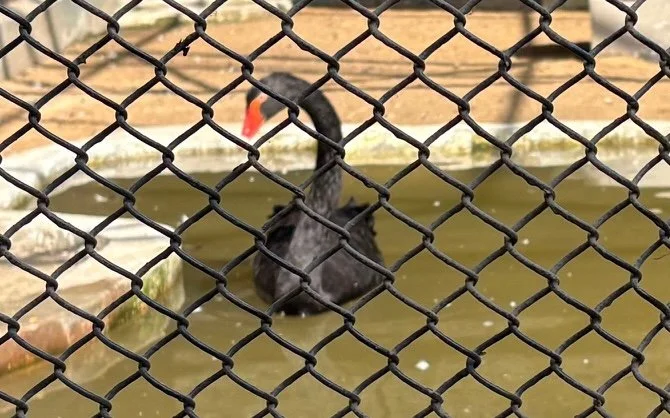
Black swan I saw at Kolkata’s Alipore Zoological Garden. I can’t know what it’s like to be this or any other creature.
KOLKATA, INDIA, JANUARY 10, 2026. India, which I’m just about to leave, shatters my habituation. It smushes my face in truths that are always right there before me at home but to which I become accustomed. Like the unknowability of others, which philosophers call the problem of other minds and I call the solipsism problem.
A novel I’m reading in India, What We Can Know, is making me even more acutely aware of my cluelessness, especially when it comes to what matters most. I’ll return to the book below.
Certain things we must learn over and over again. Or I must, anyway. I studied calculus in high school in 1971, again in college a decade later, again in 2020/2021 during my quantum experiment. Could I solve a differential equation now? Nah. I’d have to re-learn limits and all that jazz all over again.
I forget about limits, derivatives and integrals because I don’t need them. I forget about the solipsism problem because dwelling on it exhausts me, and at home I hang out with people I convince myself I know. But sometimes the solipsism problem is inescapable, like during this trip to India.
I spend five days in Delhi and five here in Kolkata. I take a train to the Taj Mahal, ride a barge called “DESIRE” on the Ganges. I gaze upon a white tiger and black swan at a zoo in Kolkata. I drive in taxis, rickshaws, buses past throngs of men, women, children who look purposeful whether walking, standing, sitting, lying.
But what is their purpose? I try and fail to imagine the lives of people I pass. I’m not a fan of multiverse theories. But India reminds me that each of us lives in a multiverse consisting of billions of alien worlds--that is, other humans.
Not to mention other animals. What is it like to be a white tiger in a Kolkata zoo? A black swan? Overwhelmed, I fall back on cliches: India, land of splendor and squalor! What choice do I have?
Scientists trying to grok spiral galaxies or schizophrenia must resort to simplification, generalization, reduction. So must humans trying to survive an ordinary day, commuting to a joyless job, squabbling with a spouse and so on. So must an American exposed to India for the first time.
In his book Conquest of Abundance, anti-intellectual intellectual Paul Feyerabend deplores our compulsion to jam the fantastical, incongruous odds and ends of existence into simplistic theories, philosophies, theologies.
Yeah, but Paul, if we didn’t generalize, if we saw things as they truly are, we’d be gibbering idiots! We’d be like James’s babies, lost in blooming, buzzing confusion. We’d have to retreat, like the poor protagonist of the Borges fable “Funes the Memorious,” into a darkened room.
Our brains automatically and necessarily resort to abstraction, especially when it comes to other humans. If I lacked this essential cognitive function, strolling through a Kolkata zoo would drive me mad in seconds.
It occurs to me that the idea of oneness, central to Hinduism and Buddhism, is a response to the terrifying, multitudinous otherness of things. Buddha and other sages assure us all things are really one thing, which means all people are really one person. Thou are that. One actor plays all parts of this strange, strange play, including your part. So don’t fret too much over others’ otherness.
All right, now back to What We Can Know. My stepmom Lois gave me this Ian McEwan novel for Christmas, and I decide to read it in India. It turns out to be uncannily apt, because it’s about the varieties of unknowability.
The novel’s first part concerns what you might call postmodern unknowability. A literary scholar a century hence, after a climate-change catastrophe, tries to reconstruct what happened at a legendary 2014 dinner at the home of a famous poet.
At the dinner the poet read a poem he wrote for his wife, who was celebrating her birthday. That much is known. But the poem has been lost. The scholar tries to reconstruct what was in the poem based on emails, social media posts, texts and other digital bric a brac preserved in Nigerian servers.
Our clues to the past are always fragmentary and often riddled with errors and deceptions. The scholar must interpret these flawed data, and he can finally only imagine, guess, what was in the poem and what really happened at the dinner. This is the unknowability over which postmodernists obsess, and which leads them to view all histories, theories, explanations with skepticism.
The second part of What We Can Know veers from postmodern unknowability to what you might call romantic unknowability. McEwan reminds us we never really know what’s going on in the mind of our beloved. Does she really love you? Maybe, maybe not. Maybe she doesn’t know herself. What is love, anyway?
If she is seeing other men, does that mean she doesn’t love you? Maybe, not necessarily. Walking around India, I am struck by Indians’ otherness. Reading McEwan between visits to shrines to Gandhi and Tagore reminds me that lovers are others, too.
For me, postmodern unknowability is an intellectual puzzle. It’s fun to ponder, like the many-worlds interpretation of quantum mechanics, but I don’t take it too seriously, it doesn’t keep me up at night. Same with the solipsism problem, at least when it comes to people in general.
Romantic unknowability, on the hand, which is a particular manifestation of the solipsism problem, does keep me up at night. My inability to know, really know, the mind of my lover is not a mere intellectual conundrum. It matters to me a lot, it bears directly on my happiness.
The only way to “solve” this problem is to stop playing the game of love, to withdraw from the arena. I’m not ready to do that. Fortunately, I have an enormous capacity for self-gaslighting, that is, for convincing myself that everything is fine. That helps me deal with romantic unknowability. She definitely loves me.
Now I’m headed back to the U.S., and here’s the funny thing. I thought the solipsism problem would become less pressing once I returned to my native land, but I fear if anything it will become even more inescapable.
Millions of my fellow Americans embrace values and beliefs utterly incomprehensible to me. They revere a narcissistic, cruel bully. They think it’s cool for an agent of the government to shoot an unarmed woman to death. My own country is even more alien to me than India was. That might keep me up at night, too.
Further Reading:
For a full list of my columns, see “About Cross-Check.”