

“Auntie Mame,” “The Dead” and My New Year’s Resolution
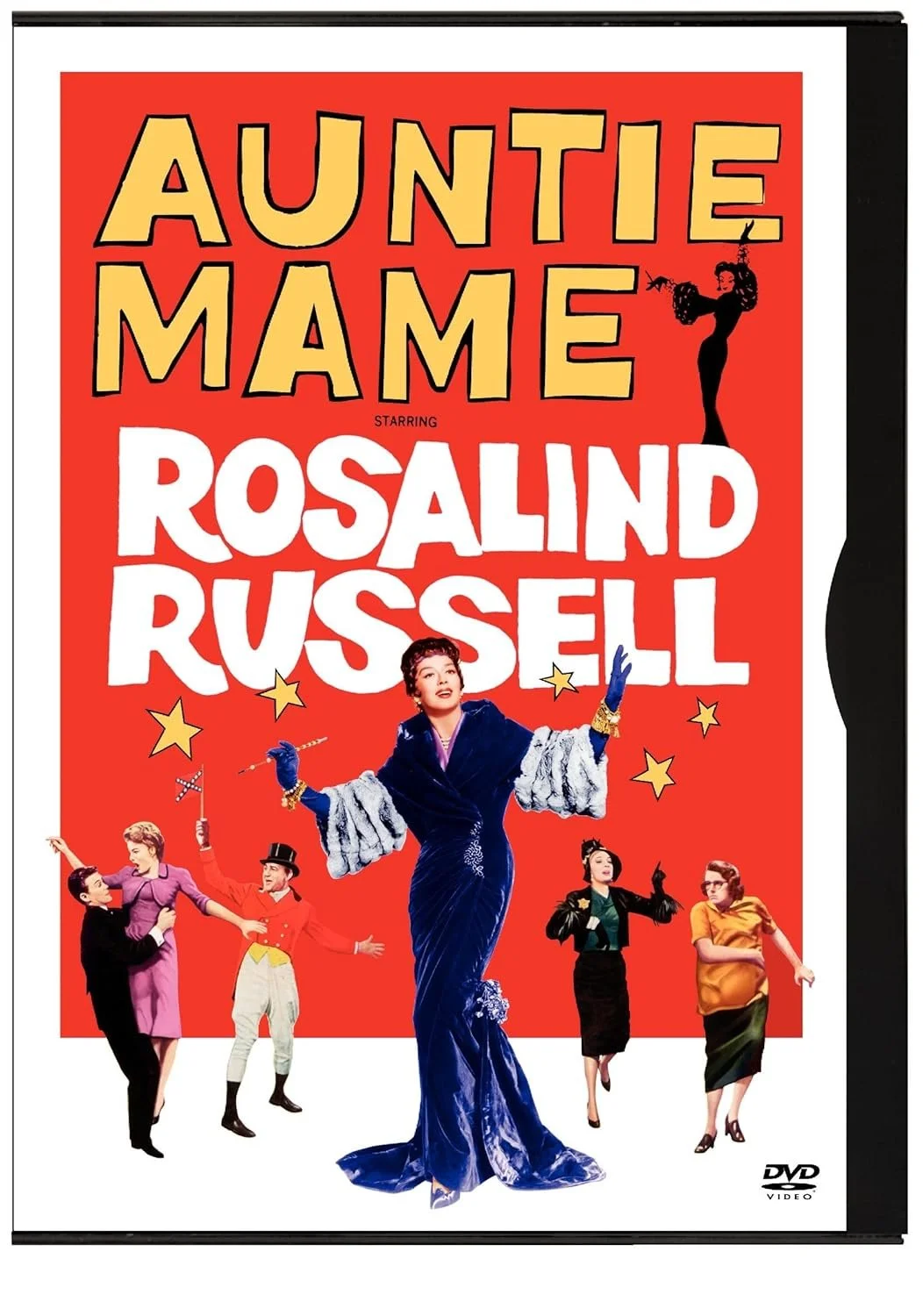
Mame exhorts us to Live! Live! Live! But don’t be a dick.
DELHI, INDIA, JANUARY 1, 2026. [See Note 1.] It’s a truism of physics as well as mysticism that this thing, whatever this is, is one, or at least has much in common, with that thing, whatever that is, if only because all things sprang from the big bang and are made of quarks and electrons and whatnot pulled and pushed by gravity and electromagnetism and so on.
And if that’s true of the entire universe, that there is a kinship between even apparently incongruous things, it’s surely true of artefacts like movies and literature, which all spring from human brains. Right? [See Note 2.]
In this column, I’ll consider resonances between two artefacts that at first glance seem quite unalike: “Auntie Mame,” a frothy 1958 flick, and James Joyce’s melancholy tale “The Dead.” Who knows, maybe I’ll eke a New Year’s message out of this exercise.
I’ll start with “Auntie Mame.,” which Vicki recently convinced me to watch with her. It’s one of her favorite movies, she hoped it would infuse us with holiday spirit.
I asked, Is “Auntie Mame” the one with Natalie Wood as a stripper? No, Vicki replied, that’s “Gypsy”! My mix-up is forgivable. Rosalind Russell stars in “Gypsy” as the stripper’s pushy stage mom and in “Auntie Mame” as Mame.
“Mame” opens in the Roaring Twenties, just before the big crash. Mame is presiding over a party with her pals in her posh Manhattan apartment. Mame is a brassy, hard-drinking gal who digs spangly outfits and brandishes a cigarette holder like a rapier. She has a suitor, but she refuses to be tied down, she’s a free spirit.
The set-up is that Mame’s estranged brother kicks the bucket and leaves his pre-teen son, Patrick, in Mame’s care. You’d think the kid would cramp Mame’s style, but she loves him to death. She tussles with a banker who controls Patrick’s money and wants to stick the boy in a private school away from Mame’s corrupting influence.
The stock-market crash of 1929 wipes Mame out, but an adorably goofy oil baron--played by Forrest Tucker of “F Troop” fame! Kinships!--falls for her. Mame marries the oil guy for love, not money, but still, she’s rich again. Yay! She and her doting dude set off on a trip around the world and have a ball until the big doofus tumbles to his death in the Alps.
The merry widow returns home and finds that her nephew Patrick, brainwashed by those snooty private schools, has grown up to be a prig. He’s engaged to a snobby girl whose rich, snobby parents utter not-so-veiled antisemitic slurs. Mame nudges her nephew into dumping the awful fiancée and hooking up with Mame’s penniless but kind secretary.
I found “Auntie Mame” too slapsticky at first, but it grew on me, because Mame, the wisecracking aging flapper, grew on me. She spells out her philosophy in one of her many monologues: “Life is a banquet, and most poor suckers are starving to death! Live! Live! Live!” Yeah, don’t let snobs and scolds hold you back.
That doesn’t mean “Grab what you can and to hell with everyone else,” the dominant ethos of our mean-spirited, hyper-capitalist age. Mame is a tough cookie, sure, but she’s also open-minded and big-hearted. Her implicit addendum to “Live!” is “and let live.” Carpe diem, tomorrow you die, but don’t be an asshole. [See Note 3.]
Not exactly a novel message, but what is? Art just gets us to see old truths anew.
Okay, on to “The Dead,” the final story of Joyce’s 1914 collection “Dubliners.” I re-read “The Dead” a week ago after Martin Levin, a Facebook friend, said he reads it every Christmas. Yeah, I thought, that’s what I should do to counter the holiday blues, re-read “The Dead”!
Joyce describes a pre-Christmas party held every year by two elderly sisters, Kate and Julia. Lots of dancing, drinking, singing, eating, chitchat. Joyce’s style is cinematic. He hovers above the action to convey the party’s manic collective inanity, then zooms in on individuals: self-righteous Miss Ivors, lecherous Mr. Brown, drunken but sweet Freddie Malin.
We see the action primarily through the eyes of Gabriel, the nephew of Kate and Julia. He’s a teacher, husband and father, who fancies himself an intellectual. He carves the goose and gives an after-dinner speech that flatters the party’s hostesses, Kate and Julia. He fears his sentimental, florid toast will fall flat, but it’s a hit, Kate and Julia tear up, others applaud.
As the party winds down, Gabriel, pleased with himself, spots his wife, Gretta, standing at the top of a stairway, in shadow, and he’s overcome with pride and desire. As they take a carriage to a hotel, memories of their secret, intimate life together overwhelm him. He can’t wait to be alone with her in their hotel room.
When they’re undressing, however, Gretta seems distracted, far away. Annoyed, Gabriel asks what’s wrong, and she says someone at the party sang a song a boy she once knew sang. The boy loved her, and he died of a broken heart because she couldn’t be with him.
After this revelation, Gretta falls asleep, leaving Gabriel devastated. How can a foolish, middle-aged mediocrity like him compete with his wife’s youthful, passionate dead lover? The story ends with Gabriel staring out the hotel window at snow “faintly falling, like the descent of their last end, upon all the living and the dead.”
“The Dead” begins with a party, a synecdoche for the social performances and obligations that occupy us for most of our anxious waking lives. Then Joyce veers into a contemplation of the desire lurking beneath the surface of things before wrapping up with a vision of death. Eros and Thanatos, baby, the fundamental forces of the human condition.
Death intrudes during the party, too, for example when Gabriel wonders whether frail Aunt Julia will be alive for next year’s Christmas bash. Joyce doesn’t rub our faces in our mortality, as Poe does in “The Masque of the Red Death.” But Joyce does call his story “The Dead.”
So what’s the overlap between “The Dead” and “Auntie Mame”? The movie is a comedy, so all ends well. “Mame” alludes to desire and death only offhandedly, in a jokey manner, and its characters are cartoony, especially compared to those of “The Dead.”
I nonetheless see “Auntie Mame” as complement, and rejoinder, to “The Dead.” Yeah, we’re all doomed, and life is hard, it breaks your heart, but it can be fun, too, filled with love and adventure. Joyce would agree. He ends Ulysses with Molly Bloom’s ecstatic “Yes,” a sexy synonym for Mame’s “Live!”
And that brings me to my New Year’s resolution: Say “Yes!” to life, and to love, and don’t be a dick. Vicki doesn’t need this reminder, you don’t either, I’m guessing, but I do.
Best wishes for 2026.
Note 1: I’m posting this column from India, where it’s already January 1, 2026. Hence the discrepancy between my dateline and the date listed above it.
Note 2. A couple of decades ago, when my kids were still in their Pokemon phase, I took them to a Pokemon flick, I can’t remember which one, and at some point I realized to my astonishment that this godawful piece of dreck was making the mystical point that all things are really one thing, thou art that.
Note 3: Philosopher Owen Flanagan says a key component of living a good life is “not being a dick.”
Further Reading:
This column is related, sort of, to all the other columns on this site, which are listed under “About Cross-Check.”