

Willy Loman and The Ruff-Tuff Cream-Puffs
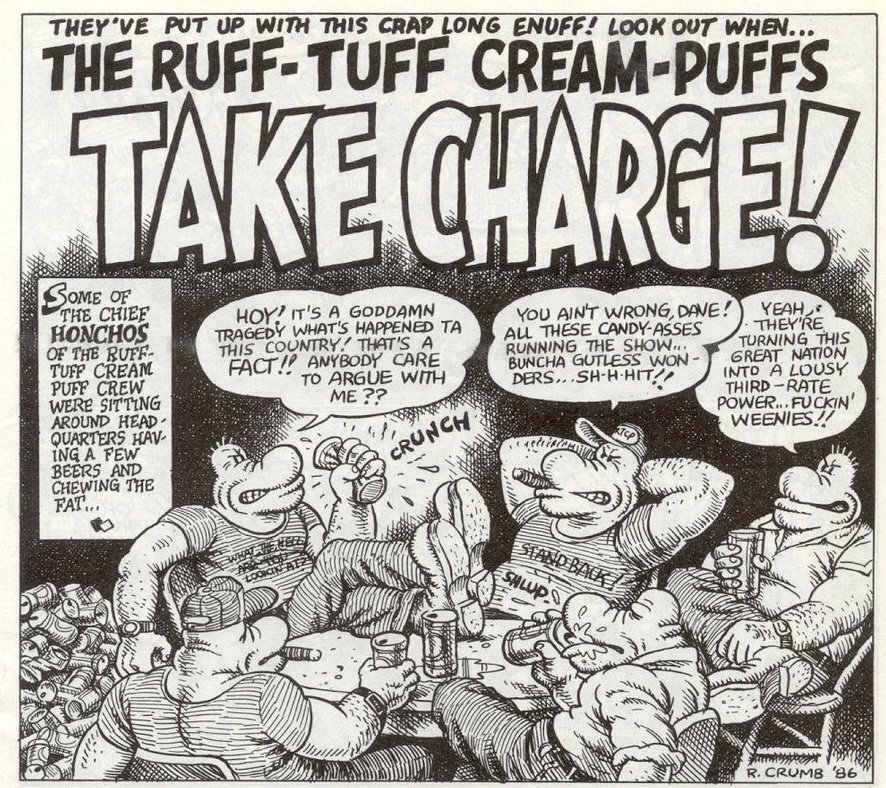
This comic strip by Crumb, published in 1987, serves as a grim complement to “Death of a Salesman.”
HOBOKEN, JUNE 28, 2026. Great art, like “Death of a Salesman,” always speaks to us, but what we hear can change.
Vicki somehow got us tickets to the acclaimed revival of the 1949 play, which stars Nathan Lane as Willy Loman, the salesman, and Laurie Metcalf as his wife Linda. The casting of actors best known for comedy in this iconic tragedy is bold.
So is the set. The play unfolds for the most part in the modest Brooklyn house where Willy and his wife Linda raised their sons Biff and Happy. But the set looks like a vacant lot, all grimy grays. In the stark, slanted lighting, everyone casts a long shadow, especially poor, doomed Willy.
Tragic heroes are driven by a trait at once ennobling and malignant. MacBeth is undone by ambition and devotion to his Lady, Willy by his ferocious belief in himself, which has become delusional.
A tragic hero should make our hearts ache. But Willy Loman, as played by Lane, grates on me. He’s not a battered warrior raging against the dying of the light. He’s a tiresome blowhard, preening one moment, wallowing in self-pity the next. He’s not only “liked,” Willy insists, he’s “well-liked.” But not even his neighbor and only real friend, Charley, likes him.
Willy poses as a great provider, husband, father, but he’s a hollow man, a phony. He can’t pay his bills. He cheats on his wife. He loves his sons only to the extent that they reflect well on him. Willy lies incessantly to others and to himself. When his wife tries to get a word in edgewise, Willy yells that she talks too much. Ugh.
No, I do not pity Nathan Lane’s Willy. I pity his wife and older son, Biff, who see Willy for what he is and love him anyway. Maybe they are the tragic heroes, undone by love. But the wife and son start getting on my nerves, too. Their devotion to Willy seems less noble than masochistic.
At some point, Lane’s cadences and intonations start reminding me of someone. Someone who relentlessly puffs himself up, spouting one falsehood after another, demanding that we believe him. Someone who indulges in interminable stream-of-consciousness rants fueled by rage and self-pity.
I’m not alone in hearing echoes of Trump in Lane’s performance. NY Times theater critic Helen Shaw ends her review this way: Willy “isn’t Everyman: He’s a specific, recognizable kind of danger. If this is Willy as a ‘common man,’ just imagine him with power. Sitting at the Winter Garden, I did--and I recognized him. My blood froze to ice.”
Do Nathan Lane and his director, Joe Mantello, want us to hear “Salesman” in this way? I can’t be sure. But Mantello cast a black actor, K. Todd Freeman, as Willy’s neighbor, Charley, whom Willy treats with condescension even when Charley offers his help. Mantello thereby draws attention to Willy’s whiteness, changing the play’s meaning.
Consider Linda Loman’s defense of her husband: “Willy Loman never made a lot of money. His name was never in the paper. He’s not the finest character that ever lived. But he’s a human being, and a terrible thing is happening to him. So attention must be paid.”
These lines once meant that every human life matters. Those who falter in the contest of life, the poor, the infirm, the old, deserve our respect. Miller’s play is often seen as an indictment of capitalism, which turns humans into disposable commodities, a means to the end of profit.
Now, Linda’s insistence that “attention must be paid” to Willy annoys me. She reminds me of pundits who, after the 2016 election, urged liberals not to disdain the “deplorables” who voted for Trump. We should feel sympathy for these poor white men! They are in pain! They feel disrespected! Reading Hillbilly Elegy by this fellow J.D. Vance might help. Ugh.
I can no longer muster sympathy for the white men, and women, too, who have propelled Trump and his cronies to power. Our political plight is captured by another work of art I re-encountered recently, which serves as a grim complement to “Death of a Salesman.”
When Robert Crumb published “The Ruff-Tuff Cream-Puffs Take Charge” in 1987, the strip was a humorous comment on right-wing militias and perhaps the self-destructive tendencies of fascism. Now Crumb’s fable, which recently popped up on my Facebook feed, seems like an only slightly exaggerated rendering of reality.
The Ruff-Tuff Cream-Puffs are brawny, guffawing, leering thugs. Think Proud Boys and the Tate brothers. They’ve got jacked-up bodies, like RFK Jr. They revel in violence, like Pete Hegseth. They sneer at wokeness, like Stephen Miller. Only pussies care about human rights. Life is a brawl, a cage match, and you’ve got to be a bad-ass to come out on top. Hoo-haw!
Why “Cream-Puffs”? Because underneath the bravado, these bullies are insecure. They bawl if bigger bullies punch them in the face. But Cream-Puffs can do lots of damage if they seize power, as they do in Crumb’s tale.
The Cream-Puffs invade the White House, kill the wimpy President, take charge of the country. Then they start turning on each other, until eventually they’re all dead. The “wimps” re-emerge to clean up the mess. That’s Crumb’s happy ending.
Will the real-world Cream-Puffs destroy themselves? Who the hell knows. Ruff-Tough Cream-Puffs reign. They haven’t just taken over Washington, D.C. They dominate corporate America, too. The world’s first trillionaire is a Ruff-Tuff Cream-Puff. Liberal democracy is beginning to look like a passing fad.
I have no sympathy for the Willy Lomans, and Linda Lomans, who got us into this mess.
Further Reading:
For a complete list of columns on this site, check out “About Cross-Check.”
MORE DEPRESSING NEWS: Holtzbrinck Publishing just sold Scientific American, for which I’ve written for four decades, to LabX Media Group. Read my defenses of the magazine here and here.