

Okay, AI Is Cool. But I Still Loathe It
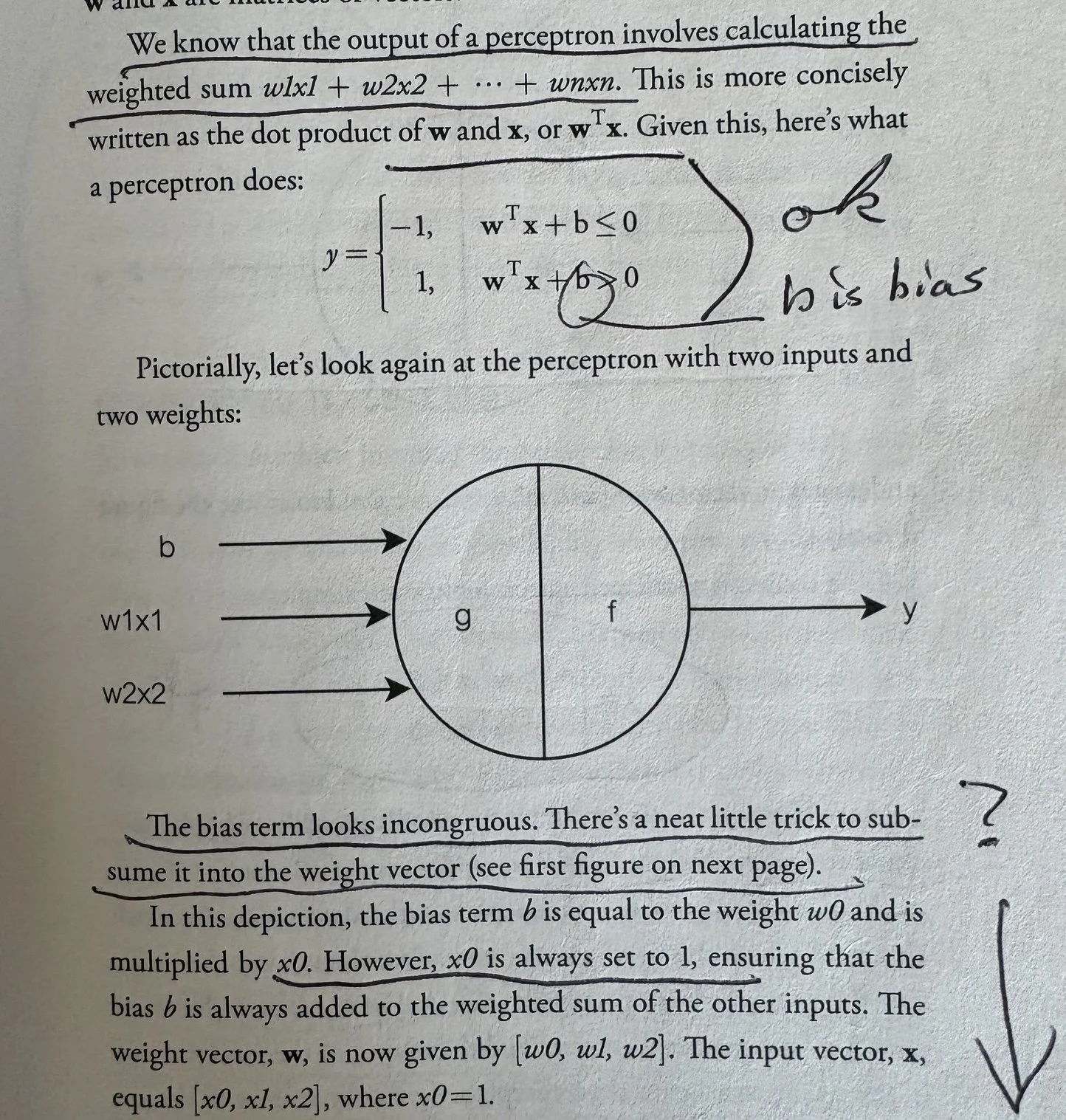
This diagram of a perceptron, an early machine-learning method, might appear cryptic, but Anil Ananthaswamy explains it clearly in Why Machines Learn.
HOBOKEN, JULY 18, 2026. In December 1985, I visited the Nevada Test Site the day before scientists detonated a nuclear device in a tunnel bored into the side of a mountain. I went to Nevada because I hated nuclear weapons and thought research on them should cease.
But as I spoke to scientists, I became entranced by the technical details of their research: What exactly do you hope to learn from an explosion? How do you ensure instruments record data in the split second before being incinerated?
I got flashbacks to being an 11-year-old boy blowing up ship models with cherry bombs. I wished I could witness one of the violent underground experiments. I wrote up what I learned in a 12-page report for IEEE Spectrum Magazine filled with fetishistic details. Reading between the lines, you could see I thought nuclear tests were cool.
I’m having a similar reaction to artificial intelligence. Although AI (unlike nukes) can be useful, I fear its net effects will be catastrophic. I’m not worried about superintelligent robots destroying us, that’s sci-fi bullshit. I’m worried about rich, powerful humans using AI to become more rich and powerful, regardless of the costs to the rest of us.
Firms peddling AI—call them “AI pushers”—have designed AIs to be addictive. Almost everyone I know, young and old, is using AI almost all the time for almost everything. People I admire rave about how fantastic AI is for this and that.
Meanwhile, AI pushers are rewarding politicians who do their bidding and crushing those who defy them. Pushers are paying human experts to help them replace human experts. Pushers are erecting monstrous, energy-sucking, climate-warming data centers. Pushers are peddling AIs that monitor, control and kill people.
I’m a science writer who teaches at a tech school. I can’t ignore AI. Last month, I decided to educate myself about this civilization-transforming technology. More specifically, I set out to learn the math that makes machine learning possible. I began reading Why Machines Learn: The Elegant Math Behind Modern AI by Anil Ananthaswamy.
I have doubts about my machine-learning project. I might be indulging in misplaced reductionism. I don’t need a degree in nuclear physics to know hydrogen bombs aren’t healthy for children and other living things. A course in neuroscience won’t give me helpful insights into my President’s cruel shenanigans.
And learning “the elegant math behind modern AI” won’t make me better-equipped to oppose AI pushers. Nor will my machine-learning project qualify me to weigh in on whether AIs are conscious or might be soon. That debate is irresolvable because of the solipsism problem. I can’t be sure my fellow humans are conscious, let alone Claude or Grok.
Despite these misgivings, I kept reading Why Machines Learn, and gradually another problem emerged. I found the book almost too gripping. It’s a classic example of what I call “Holy shit” science writing, filled with details that make you go, Holy shit! Cool! Or words to that effect.
Machine-learning pioneer Geoffrey Hinton calls Why Machines Learn a “masterpiece.” I concur. Ananthaswamy walks you through the history of machine learning, starting with the clunky perceptron of the 1950s and culminating in transformers, the breakthrough that led to ChatGPT and other clever large language models.
You learn just enough linear algebra, calculus and probability theory to understand key advances over the past 70 years. You pick up a little neuroscience, too, because early AI researchers sought to replicate how they thought brains think.
Ananthaswamy also tells tales about Hinton, Frank Rosenblatt, Donald Hebb, Walter Pitts, Marvin Minsky, John Hopfield, Yann LeCun and other key figures. The book ends up being as much about human intelligence, and humans, as about AI and machines.
I started seeing AI as a McGuffin that set in motion a grand adventure of human discovery and invention. The book left me in awe of the persistence, ingenuity and intelligence of the humans who invented artificial intelligence.
AI exists because humans thought hard about what it means to think—and to see, hear, recognize, analyze, remember, compare, distinguish, decide. Scientists seeking to replicate human intelligence solved one seemingly insurmountable problem after another.
Ananthaswamy draws attention to the loopy meta-ness of his book: He has learned about machine learning so he can help us learn. He speculates that “the same elegant math might underpin” human and machine intelligence.
Why Machines Learn reminds us over and over that the human mind and brain are wondrous things. Think of all the neural computations required for me to write and you to comprehend this sentence.
That brings me to a bitter irony: AI threatens the kind of intense inquiry that made AI possible. AI pushers are using artificial minds, made by human minds, to replace—and to deceive, manipulate, corrupt, control, destroy--human minds.
What can be done? A ban on AI looks even more unlikely than a ban on nuclear weapons. Part of the problem is that, yes, AI can be useful. My son Mac owns a tree-care business. When his dump-truck broke down, he consulted ChatGPT, and it suggested three possible fixes of the truck. Mac tried the first fix, and it worked. Impressive.
In his new book The God Test: Artificial Intelligence and Our Coming Cosmic Reckoning, Robert Wright offers ideas about how to maximize the upside and minimize the downside of AI. I won’t say more about Wright’s book now, because I’m going to talk to him about it in a public zoom event on October 6.
In the meantime, I’ll keep pursuing my machine-learning project. If nothing else, the project might help me keep my job. I’ll mention it in my faculty-activity report in the fall. Deans dig that sort of thing.
My project might also impress my students. Instead of just ranting about AI in class, as I have been for the last three years, I’ll grant that AI is kind of cool. I’ll casually drop references to multi-dimensional vectors, hyperplanes, Bayesian statistics. AI pushers might be shoving us toward the brink of catastrophe, but I still need to keep my student ratings up.
Further Reading:
An AI-Hater Tries to Learn the Math That Underlies AI
An AI Critic Talks to a Tech School
Should Killer Robots Have Rights?
What Is It Like to Be a Superintelligent Machine?
How AI Moguls Are Like Mobsters
Cutting Through the ChatGPT Hype