

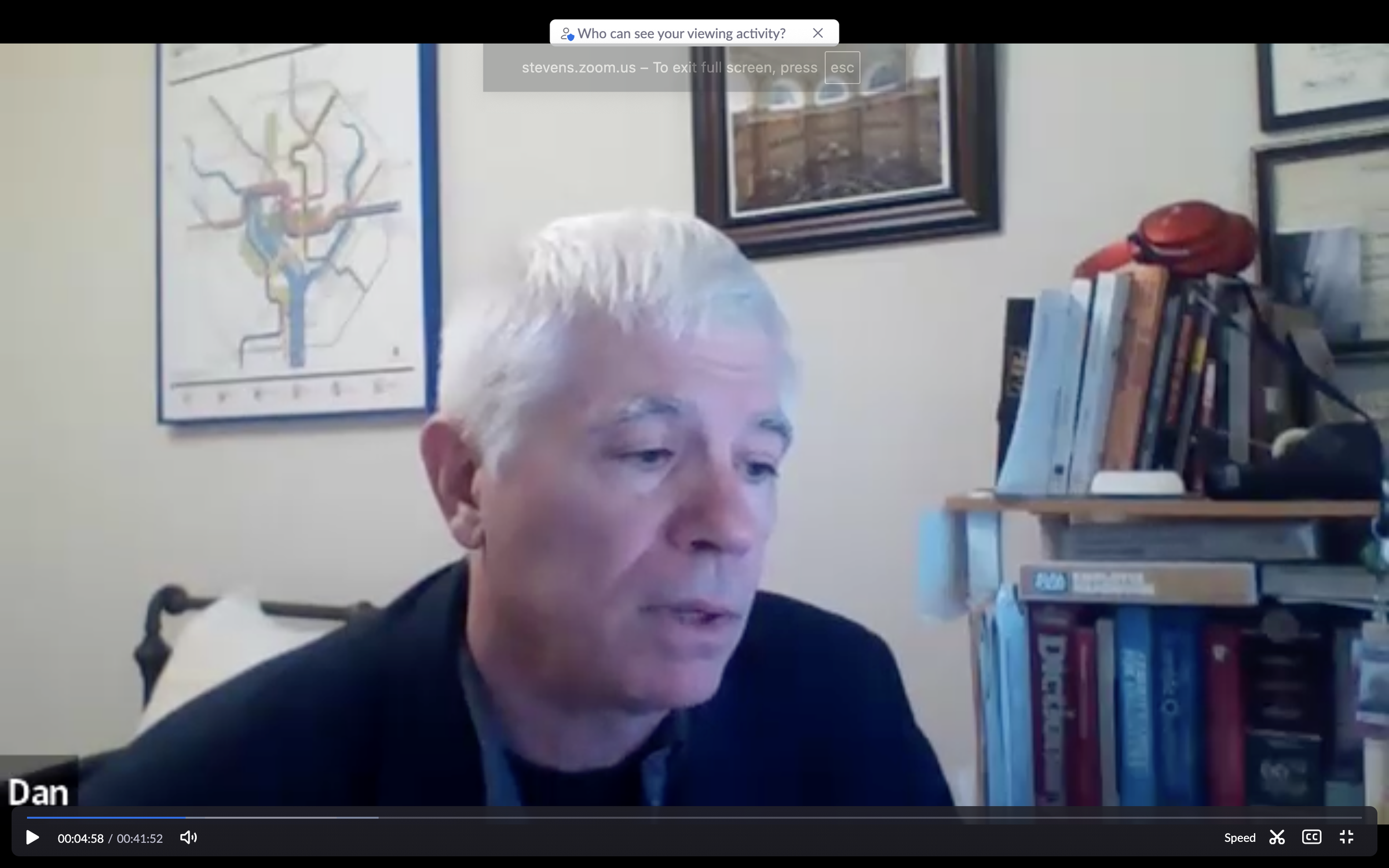
Science journalism has never been more important, or imperiled. “It’s a tough time for both freelancers and staffers,” Dan Vergano, fired by Scientific American’s new owners, told me via zoom.
HOBOKEN, JULY 13, 2026. I shouldn’t write a eulogy for something that’s not dead. But I fear for the future of Scientific American--and science journalism as a whole. Attention must be paid.
On June 23, Nature Springer, Scientific American’s British-German parent company, sold the magazine to LabX Media Group, a Canadian firm that also owns Discover magazine and The Scientist. LabX, which describes itself as “a leading worldwide science publishing company that delivers meaningful industry content and integrated marketing solutions for the scientific community,” promptly fired 15 Scientific American staffers.
Those laid off include senior editor Dan Vergano, to whom I reached out for comment. Vergano is a veteran of our racket. Before joining Scientific American, he worked for USA Today, National Geographic, Buzzfeed News and Grid News and freelanced for The Washington Post and other publications.
The sale of Scientific American, Vergano points out, follows layoffs of science journalists at The Wall Street Journal, Washington Post and other major media. Two of Vergano’s former employers, Buzzfeed News and Grid News, no longer exist. “It's a tough time for both freelancers and staffers in our business,” he tells me via zoom.
WIRED, Stat News and other publications and newsletters still turn out good science journalism, Vergano says. So does The New York Times, which Vergano describes as “this weird dreadnought cruising through the wreckage of all the other little ships around it.” But he adds, “We're in a greatly diminished journalistic enterprise in this country.”
My relationship with Scientific American has had ups and downs. I was a staff writer from 1986 until 1997, when I was fired in a dispute over my book The End of Science, which advertising executives thought was bad for business. I started freelancing for the magazine again in 2005, and from 2010 until 2023 I churned out more than 500 online columns.
So I’m fond of Scientific American, the old magazine matters to me, many former colleagues remain friends. That’s why I’ve recently defended Scientific American against attacks of right-leaning critics (see here and here). That’s why I’m writing about it again now. Attention must be paid.
Like many publications in the internet era, Scientific American has struggled to make a profit. But online commenters (see here, here and here) speculate that Springer Nature unloaded the magazine because staff were forming a union and demanding editorial freedom from corporate control.
Vergano confirms these reports. “There was significant corporate influence and interference” before the sale to LabX, he told me. “That's why we formed a union,” because staffers “were worried about this interference.”
In 2023 Scientific American hired Vergano, who is based in Washington, D.C., to help edit opinion columns. After Trump’s re-election in 2024, Vergano had a hard time convincing scientists to weigh in on Trump’s science policies. Scientists “were scared to death about having their funding yanked.”
Under management direction, Vergano started writing opinion columns himself under the tag “Argonaut.” “I was channeling things that scientists were telling me but were scared to say for themselves,” he says.
In May 2025, “Argonaut” posted a column with the headline, “Science Tells Us the U.S. Is Heading toward a Dictatorship.” Shortly thereafter, Scientific American management discontinued staff-written opinion columns and “greatly ratcheted down” outside op-eds.
Although Vergano no longer wrote opinion pieces, he kept reporting news stories on the Trump administration’s attempts “to rewrite the rules for how science is done in this country.” (To get a sense of Vergano’s range, see this list of his stories, which include an account of how a “dingbat” like Elon Musk could become so successful and an examination of Jeffrey Epstein’s ties to leading scientists.)
Vergano dismissed accusations that Scientific American has recently become too political, or “woke.” These complaints occasionally pop up in “the op-ed pages of The New York Post or some partisan piece of garbage like that.” Scientific American has always had a political edge, Vergano points out. People have complained that Scientific American is “un-American” since “the McCarthy era.”
Vergano worries that instead of covering the collision of science and politics, Scientific American’s new owner, LabX, will turn the magazine into a platform for “sponsored content,” like “Boeing brings you the wonders of aerospace.” [See Postscript.] Vergano’s concerns are well-founded, if the fate of another LabX publication, Discover, is any indication.
Founded in 1980 by TIME (remember that former media colossus?), Discover was once an influential monthly magazine (for which I wrote articles on the neural code and peyote). Now Discover is published four times a year. In an email, a former Discover editor calls it a “Potemkin magazine,” a shell of its former self.
Vergano worries about the effects of artificial intelligence on journalism. Springer Nature, he says, encouraged magazine staff to use AI to “improve search engine results.” Meanwhile, AI is swamping the “public sphere” with “garbage.”
Vergano is concerned that major media are forming “partnerships” with AI firms. Media that sell content to OpenAI, Google and Meta are “cutting their own throats,” Vergano says. “You're essentially training the AI to do your job, a crappy version of it, more cheaply. And as we know, free always wins.”
Large language models such as ChatGPT can easily generate what Vergano calls “study says” stories. A staple of science journalism, “study says” stories are non-technical descriptions of scientific papers.
But good science journalism, Vergano says, requires good science journalists. Even his bosses at USA Today understood that. In 2011, when a tsunami swamped the Fukushima nuclear plant, USA Today’s editor-in-chief approached Vergano and asked, “Are we fucked?”
Vergano, who has a degree in engineering, was qualified to respond to that question. To report on stories as consequential as Fukushima, he says, media companies need reporters “who know the difference between fission and fusion.”
USA Today executives “weren't always nice people,” Vergano notes, but while focused on profits, they also felt obliged to inform the public with decent journalism. Vergano worries that today many executives focus solely on making money. “In my opinion, Elon Musk and his ilk feel no sense of obligation whatsoever to the public.”
Now more than ever, we need skilled, tough journalists, like Dan Vergano, to cover climate change, pandemics, weaponized artificial intelligence, nuclear weapons, genetic engineering and other consequential science stories. Science journalism has never been more important, or imperiled, than it is right now. Attention must be paid.
Postscript: Vergano informs me via email that Scientific American, post-sale, is still covering science policy (see here and here). “So that is a good thing for the magazine,” he says. He also sends a link, posted last spring, to Scientific American’s policies on “Standards and Ethics,” including “Use of Artificial Intelligence.” I’d like to add that The New Yorker and New York Review of Books, to which I subscribe, also feature excellent science writing.
Further Reading:
Scientific American Loses Its Bold Leader
Scientific American and the Anti-Woke Bros
Being a Science Critic When Science Is Imperiled
Advice to Aspiring Science Writers: Remember Marx