

Brain Explorer Rethinks Consciousness
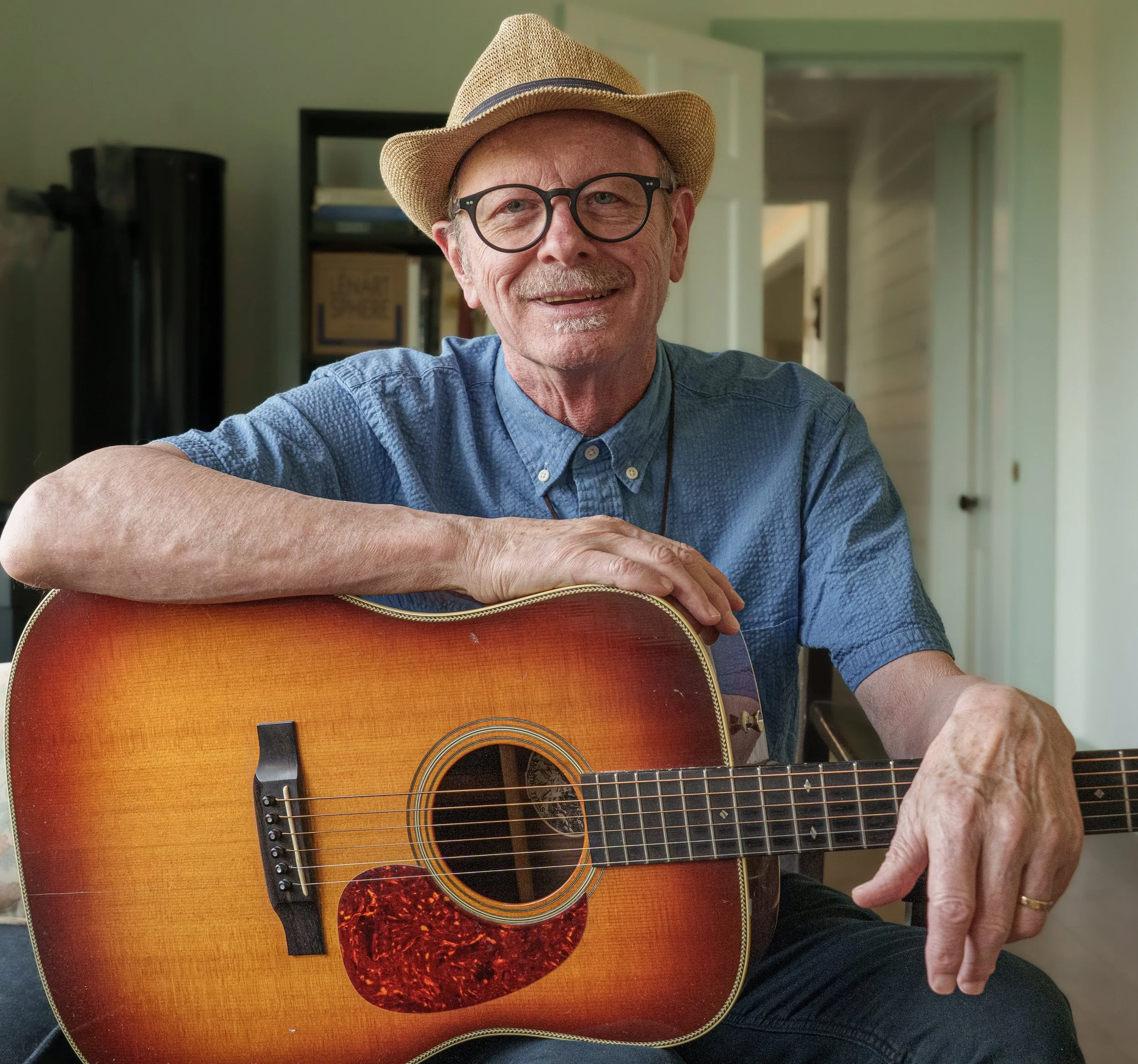
HOBOKEN, JUNE 8, 2026. Joseph LeDoux is a cool cat. He’s the lead singer and songwriter for the band The Amygdaloids. I’ve seen them, they rock. As you might guess from the name of the band and its first album, Heavy Mental, LeDoux also studies brains. He is a pioneer in the neuroscience of emotion, in particular fear. He has popularized his work in books such as The Emotional Brain (1996) and Synaptic Self (2002). LeDoux no longer oversees a lab at NYU, his home for decades, but he’s still a force in his field. He just co-authored a paper in Neuron that knocks consciousness researchers for sloppily defining consciousness. LeDoux has always struck me as a deep thinker who loathes bullshit. This makes him an especially valuable figure in the hype-prone field of mind-body studies. Below he answers a few questions. – John Horgan
HORGAN: Do you ever regret getting into the neuroscience racket?
Are you kidding? I can’t imagine how I could have possibly had a better career. I grew up in a small town in Louisiana Cajun country and went to college at LSU. I was destined for a career in business, especially consumer protection. In the fall of 1972, I was in the final year of a master’s degree in marketing and took a psychology class called “Learning and Motivation”, thinking it would be relevant. But it turned out to be about rat brains and memory, which blew me away. I tried to get accepted into a graduate program in psychology to study the brain, but I had no credentials and most programs rejected me. Through a stroke of sheer luck, I was accepted at Suny Stony Brook on Long Island, and through another stroke of luck I ended up working with Mike Gazzaniga, an expert on split-brain patients. Four years after my master’s, I had a PhD on consciousness in the human brain, and a book on that topic that I co-authored with Mike called The Integrated Mind (Gazzaniga and LeDoux 1978). Accidentally taking that class at LSU and then stumbling across Mike at Stony Brook were crucial turning points, dominos that fell and destined me to spend the next 50 years of my life as neuroscientist, never looking back.
HORGAN: Yet, you seem to be getting increasingly annoyed by your own field lately. Is that a fair assessment?
It’s not that simple. From the start I was fascinated by human consciousness, especially emotional consciousness, but I didn’t see how to make that a career. In the early 1980s psychology and cognitive science still suffered from the behaviorist multi-decade ban on consciousness, as did the relatively new field of neuroscience (see LeDoux, 2012, 2015, 2023). So, I turned to classical fear conditioning to study emotional behavior in rats. The rat studies led me to the amygdala and fear, but I continued to think about consciousness on the side (LeDoux, 2026). In the late 80s and early 90s, and in my 1996 book, The Emotional Brain, I wrote about the amygdala as controlling unconscious emotional behavior in both rats and humans and described conscious fear in humans in terms of what Mike had come to refer to as “interpretations” via language and cognition. But my idea that the amygdala non-consciously controlled fear-like behaviors did not catch on. The amygdala became a “fear center” in the broadest sense, a location where fear-like behaviors and conscious feelings of fear were bundled together.
By the late 1990s I was a bit frustrated about where research on emotion in the brain was going and shifted my emphasis from emotion to the cellular and molecular mechanisms of learning and memory. But as time went by, the amygdala thing continued to bother me. Roughly 22 years after I started working on fear and the amygdala, I concluded that a different perspective was needed. In a 2012 article in Neuron, “Rethinking the Emotional Brain,” I proposed that we treat the amygdala’s role in danger not as a fear center but instead as the product of a defensive survival circuit, saving the mental-state term “fear” for the conscious experience. I expected that the conscious part would be rejected or ignored because many amygdala researchers had been trained by mentors that came from the behaviorist tradition. But I did not expect a rejection of the defensive survival circuit terminology since “defense” and “fear” were used interchangeably to describe amygdala-conditioned behaviors. It seemed like a way to be clear, but no dice.
Over the years I continued writing articles (e.g. “Coming to Terms with Fear, 2014”; “Using Neuroscience to Understand Fear and Anxiety, with Daniel Pine, 2016; “Semantics, Surplus Meaning, and the Science of Fear, 2017”; “Surviving threats: neural circuit and computational implications of a new taxonomy of defensive behavior, with Nathaniel Daw, 2018;” “Thoughtful Feelings, 2020; Seeing consciousness through the lens of memory, with Hakwan Lau, 2020; “What Emotions Might Be Like in Other Animals; and “As Soon as there was life there was danger” 2022. I also made the case in books (Anxious, 2015; The Deep History of Ourselves, 2019; The Four Realms of Existence 2023).
The good news is that the survival circuit thing has gained traction over the years. For example, in 2020 philosopher Raamy Jajeed wrote a paper titled “The New LeDoux: Survival Circuits and the Surplus Meaning of Fear.” I really appreciate that, but I want to emphasize it was not actually that new for me except for the terminology since the conscious/unconscious distinction long preceded the survival circuit thing. But terminology is so important for clarity.
HORGAN: When I interviewed you for my 1999 book The Undiscovered Mind, you said you’re less interested in consciousness than in personal identity, in “how our brain makes us who we are.” Do you still feel that way?
Yes, I went in that direction in my book Synaptic Self (2002), which came out a couple of years after yours. But my interests in consciousness returned in 2006 when I was invited to Oxford to spend a term thinking and talking about consciousness. I wrote a book chapter that made consciousness my top priority for the rest of my career, with the self as part of the picture (LeDoux, 2008). Then, in writing the Four Realms between 2019 and 2023, I began to see the self as an unnecessary construct. Here’s an excerpt from the book.
“The various phenomena that have been discovered while studying self and personality have, without question, provided important insights into human nature. But what if it is our scientific understanding of who and what we are that is confused. Specifically, what if our constructs are inadequate as conceptual hooks on which to hang the empirical findings that have been discovered in their name? Because these centuries-old notions obscure as much as they reveal, maybe the phenomena would be better served by a new conceptual home, one grounded in contemporary scientific conceptions and empirical research… A human being can be characterized as a composite of four fundamental, parallel, entwined realms of existence that reflect our evolutionary past and account for our present ways of being. All four are, deep down, biological. But the neurobiological realm transcends the mere biological, the cognitive transcends the mere neurobiological, and the conscious transcends the mere cognitive, and they coalesce as an ensemble of being. Together, the four realms account for what and who we are, including those aspects of us that fall under the rubrics of the self and personality.”
HORGAN: I’ve been struck, as I age, by how people I’ve known since childhood somehow stay the same. Can neuroscience explain the continuity of the self?
John Locke said conscious memory allows us to know that we are fundamentally the same as we always were. Yet, the ancient Greek philosopher Heraclitus noted that change is the only constant in life. The solution is that we use memory to construct stories, narratives or interpretations. These stitch us together over time as we change, giving us a sense of mental coherence as we age.
HORGAN: Daniel Dennett called consciousness an “illusion.” What do you think he meant by that? Do you agree with him?
Yes! My PhD research was mostly on one split-brain patient, PS. The main discovery was how his left hemisphere observed behaviors performed by his right hemisphere and made up a story, a kind of illusion, to make the right hemisphere’s behavior make sense to the left hemisphere. Some might say that this is a common strategy that neurological patients use to compensate for their deficits. But we concluded that we all do this. That the human brain evolved a way to maintain mental unity by narrating, internally or externally, explanations of unconsciously controlled actions. This one experiment stuck in my head all these years and has been what moved me. But my thoughts never progressed. Then, at the end of The Four Realms I came up with something that tied together all those decades of thinking about the role of narrations/interpretations in mental life.
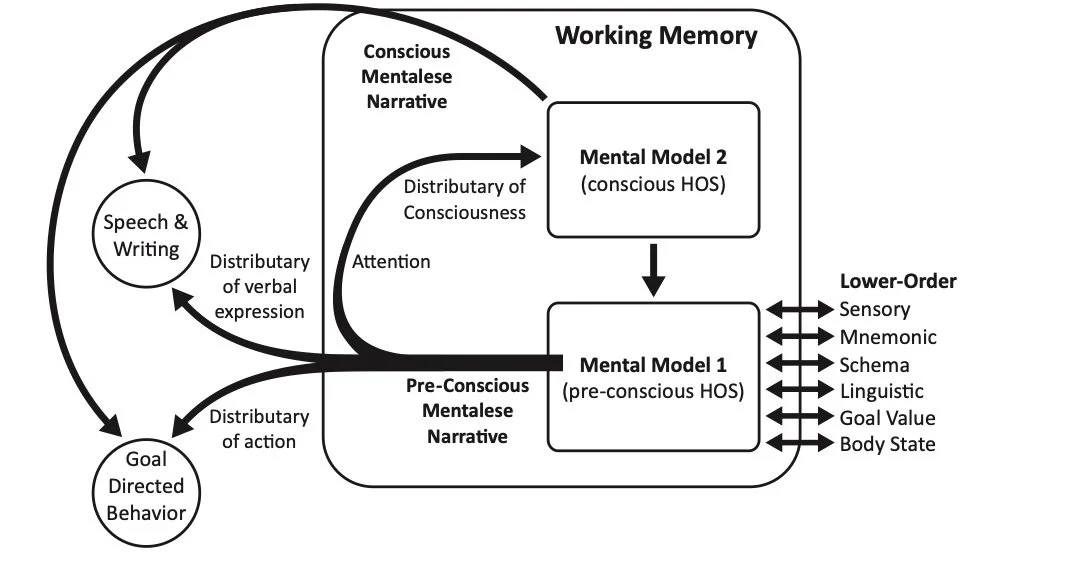
In brief, we use lower-order cognitive information processing to construct working memory mental models when thinking and having experiences. That’s not novel but the next part is. I proposed that a least two mental models are in play, one is non-conscious (i.e. pre-conscious), and the other is conscious. The very short summary is that the output of the pre-conscious model cognitively initiates goal-directed behavior and speech non-consciously. But the pre-conscious model also feeds the second mental model non-consciously to foster conscious experiences. The conscious mental model then feeds back to the pre-conscious mental model, allowing you to be conscious of what you were just conscious of thereby sustaining mental coherence moment to moment. This work in progress suggests why what we say and what we do are not necessarily fully consistent with each other, and why both are not necessarily fully consistent with what we consciously experience. That’s why we need conscious narratives to tie it all together.
HORGAN: Three years ago, you signed a letter that denounced integrated information theory, a leading theory of consciousness, as “pseudoscience.” Why did you sign that letter? And is there any theory of consciousness that isn’t pseudoscientific?
That depends on what you think pseudoscience is. My friend and collaborator Hakwan Lau, one of the leaders in getting the letter out, has pointed out to me that different people have different views of pseudoscience, in part because there are different meanings of the term. As a result, the letter was signed for different reasons, but overall, I think most signed because of the bold and unsubstantiated claim by the IIT proponents that IIT was the only real game in town (the best theory), and because of the way the proponents fed such claims to the press. There is a new version of the debate that deals with the issues in more depth, “What makes a theory of consciousness unscientific” (IIT-Concerned, Klincewicz et al, 2025, Nature) .
Personally, I think the panpsychism angle of IIT is especially troubling. When scientists adopt panpsychism (consciousness is everywhere in the universe), they are spitting distance from pantheism (God is everywhere). I have no particular beef with panpsychism and spiritualism except when they are brought into science.
That said, IIT is not the only problem we face. In a brand-new paper in Nature by Vincent Taschereau-Dumouchel, Jun Seo, Hakwan, and me titled “The Ethical Impasse of Current Consciousness Science,” we addressed issues that we felt were interfering with progress in the science of consciousness, including research on consciousness in animals, fetuses, and AI.
HORGAN: Why hasn’t there been more progress in understanding and treating mental illnesses, such as fear and anxiety, schizophrenia and depression?
I’m glad you asked that. I will focus on fear and anxiety related problems. Emotion was a thriving research topic in animal and human neuroscience throughout the 2000s and 2010s, and much emotion research involved Pavlovian fear conditioning in the amygdala. But I was concerned. There was nothing wrong with the research. The problem was the amygdala “fear center” idea. As I noted above when discussing “Rethinking the Emotional Brain”, I proposed that the circuits underlying the feeling of fear and the behavioral and physiological response are different. Because the two circuits are activated simultaneously by the same external stimulus, we intuit that the feeling of fear must be the cause of our responses. I went on to argue that this is a confusion (a Dennett-like illusion) resulting from the mere correlation of the two events in time.
So what are the implications for psychiatry? Before going there, it’s important to note that some colleagues reject the importance of patients’ subjective experiences in mental health. For example, in response to my 2016 article with psychiatrist Danny Pine on using neuroscience to understand fear and anxiety by emphasizing subjective experience, Michael Fanselow and Zachery Pennington went so far as to say that our emphasis on subjective experience would foster a return to the psychiatric dark ages (Fanselow and Pennington, 2018). Obviously, I disagree.
I believe that the failure of psychiatry to deliver effective treatments for disorders involving fear and anxiety was due to the conflation of ancient defensive survival circuits with cognitive circuits that construct conscious feeling of fear and other emotions. Drugs that change animal behavior and physiological responses can help tame behavioral and physiological symptoms but will never effectively relieve the subjective feelings of fear or anxiety that prompt people to seek help in the first place. In other words, it is equally important, if not more so, that mental states be treated (Taschereau-Dumouchel, 2002). By the way, this applies widely, not just to fear and anxiety. We have to put the mental back into mental disorders of all types. The science of consciousness could potentially be very helpful. But consciousness scientists tend to be more interested in perception than in emotional consciousness, the most important kind consciousness in human life.
HORGAN: Does the part of your brain that does music overlap with the part that does neuroscience?
I assume this is a question about how my life as a scientist and my life as a musician became intricately entwined. It’s a long story that will be spelled out in my forthcoming book— Starting Over: A Neuro-Emotional, Cajun , Rock ‘n’ Roll Memoir, MIT Press, April 2027. In the meantime, you can explore my Heavy Mental music adventure in the musician component of my website.
CITATIONS:
Fanselow MS, Pennington ZT (2017), The Danger of LeDoux and Pine's Two-System Framework for Fear. Am J Psychiatry 174:1120-1121.
Gazzaniga MS, LeDoux JE (1978) The Integrated Mind. New York: Plenum. IIT-Concerned et al. (2023) Preprint at PsyArXiv https://doi.org/10.31234/osf.io/zsr78.\
IIT-Concerned, Klincewicz, et al. 2025 What makes a theory of consciousness unscientific?. Nature neuroscience, 28(4), 689–693. https://doi.org/10.1038/s41593-025-01881-x.
Jajeed R (2020) The New LeDoux: Survival Circuits and the Surplus Meaning of Fear. The Philosophical Quarterly vol 70, no 281. P 809-829
LeDoux JE (1996) The Emotional Brain. New York: Simon and Schuster.
LeDoux JE (2002) Synaptic Self. New York: Viking.
LeDoux JE (2008) Emotional Colouration of Consciousness: How Feelings Come About. In: Frontiers of Consciousness (Weiskrantz LW, Davies M, eds), pp 69-130. Oxford: Oxford University Press.
LeDoux J (2012), Rethinking the emotional brain. Neuron 73:653-676.
LeDoux JE (2014) Coming to terms with fear. Proc Natl Acad Sci U S A 111:2871-2878. PMC3939902
LeDoux JE (2015) Anxious: Using the brain to understand and treat fear and anxiety. New York: Viking.
LeDoux JE, Pine DS (2016) Using Neuroscience to Help Understand Fear and Anxiety: A Two-System Framework. Am J Psychiatry 173:1083-1093.
LeDoux JE (2017) Semantics, Surplus Meaning, and the Science of Fear. Trends Cogn Sci 21:303-306.
LeDoux J, Daw ND (2018) Surviving threats: neural circuit and computational implications of a new taxonomy of defensive behaviour. Nat Rev Neurosci 19:269-282.
LeDoux J (2019) The Deep History of Ourselves: The four-billion-year story of how we got conscious brains. New York: Viking.
LeDoux JE (2020) Thoughtful feelings. Curr Biol 30:R619-R623 LeDoux JE (2021) What emotions might be like in other animals. Current Biology 31:R824-R829.
LeDoux JE, Lau H (2020) Seeing consciousness through the lens of memory. Curr Biol 30:R1018-R1022.
LeDoux JE, Michel M, Lau H (2020) A little history goes a long way toward understanding why we study consciousness the way we do today. Proc Natl Acad Sci U S A 117:6976-6984. PMC7132279
LeDoux JE (2021) What emotions might be like in other animals. Current Biology 31:R824-R829.
LeDoux JE (2022) As soon as there was life, there was danger: the deep history of survival behaviours and the shallower history of consciousness. Philos Trans R Soc Lond B Biol Sci 377:20210292. PMC8710881.
LeDoux JE (2023) The Four Realms of Existence: A new theory of being human. Cambridge, MA: The Belknap Press of Harvard University Press.
LeDoux JE (2026) My Fifty Years Thinking About Emotional Consciousensss in the Brain. The Journal of Neurosciencd, in press
LeDoux JE (2027) Starting Over: A Neuro-Emotional, Cajun, Rock’n’Roll Memoir. MIT Press (due out April, 2027).
Taschereau-Dumouchel V, Michel M, Lau H, Hofmann SG, LeDoux JE (2022) Putting the "mental" back in "mental disorders": a perspective from research on fear and anxiety. Mol Psychiatry 27:1322-1330. PMC9095479 10.1038/s41380-021-01395-5
Taschereau-Dumouchel V, Hwang JS, Lau J, LeDoux J E (2026) The Ethical Impasse of Current Consciousness Science. Neuron, S0896-6273(26)00276-X. Advance online.