

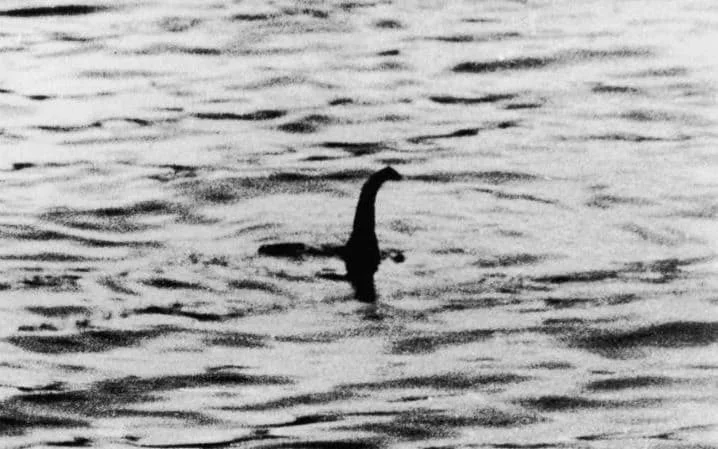
This famous photo of the Loch Ness monster turned out to be a hoax. But even without monsters, ghosts and aliens in spaceships, this world is still really, really weird.
HOBOKEN, JUNE 4, 2026. What counts as a genuine mystery, that’s worth pondering, versus a pseudo-mystery, that isn’t? I’ve been contemplating this puzzle (meta-mystery?) since touring Scotland last week.
Richard, a descendant of the MacDonald clan, picked up Vicki and me in Inverness and drove us around Loch Ness, spouting tales in Scottish brogue. We swung by Boleskine House, where wacky Aleister Crowley summoned demons; and the Well of the Seven Heads, site of an especially gory Scottish story, which Richard tells with relish.
We checked out the “Loch Ness Experience,” a tourist trap that peddles “Nessie” dolls and keychains. After paying 20 pounds each, we watched a one-hour film, projected in a series of dimly lit chambers, on “the Loch Ness legend.”
The film informed us that Loch Ness, a relic of the last ice age, is 22.5 miles long and up to 1.7 miles wide and 755 feet deep. It holds more water than all the lakes of England and Wales combined. Its waters are murky, stained brown by peat.
Saint Columba, a brave Irish monk, encountered the monster in the 6th century and made it slink back to its lair. Supposedly. The modern legend dates to 1933, when a local hotel manager claimed to have seen a whale-like beast frolicking in the loch.
That sighting got picked up by local papers, and soon Nessie became a global meme. In the 1980s, Sting sang about something crawling from “a dark Scottish lake,” and a fleet of sonar-equipped boats crisscrossed Loch Ness in search of Nessie.
At the end of the film, our group of 20 or so tourists pushed buttons to indicate whether Nessie is “real,” “nonsense” or a “possibility.” Most of the group chose “real.” Historically, that’s how most visitors vote.
I voted for “nonsense.” All those expeditions have failed to find anything resembling a monster. Alleged pieces of evidence—notably that famous photo of the long-necked, dinosaur-ish creature—have been exposed as hoaxes. According to the film!
And yet the film’s narrator keeps intoning, in effect: Science hasn’t proven there’s a monster, but it hasn’t proven there isn’t, either. The mystery endures! Our guide Richard, when I asked for his take, said pretty much the same thing: I’ve never seen Nessie, but I know folks who have, so who can say for sure?
Richard said this with a twinkle in his eye. This coy agnosticism serves the purposes of the Loch Ness tourism industry. But to my mind, Nessie isn’t a mystery, it’s a pseudo-mystery, not worth taking seriously.
Through sheer coincidence (or is it synchronicity?), two days after touring Loch Ness Vicki and I saw a play in Edinburgh about belief and disbelief. We hadn’t heard of the play, we went because the theater was right next to our hotel.
2:22: A Ghost Story turned out to be about a ghost that may or may not haunt the home of a young couple. The husband and wife and another couple argue heatedly, and entertainingly, over whether ghosts are real. The play tips toward “real.”
I’ve waffled on ghosts. In the mid-1980s, I visited friends living in an old farmhouse in Maine. My friends said the house was haunted, I said bullshit. Then one afternoon I heard what sounded like a woman crying. It freaked me out, I couldn’t explain it, still can’t. And yet I still think ghosts are figments of our imaginations, pseudo-mysteries, like Nessie.
Another encounter comes to mind. In 2019, I attended a week-long symposium at Esalen, the California retreat center, on challenges to scientific materialism. There I met Leslie Kean, a journalist who has written books on UFOs and life after death.
I subsequently interviewed Kean for Scientific American. I wrote that “although I have a hard time believing in ghosts and alien visitations, I admire the courage and professionalism with which [Kean] investigates these topics.”
Kean insists she’s just a journalist, reporting the facts; she’s “agnostic” on whether aliens and ghosts are real. But her stance strikes me as a bit disingenuous. She is a believer trying to hold on to her self-image as a rational, skeptical journalist. I can relate.
Kean says scientists are too close-minded about paranormal phenomena. “I think all aspects of ‘superhuman’ functioning--precognition, clairvoyance, telepathy, psychokinesis, and energy healing--should be taken seriously,” she told me. “They have been well documented.”
Well documented? Really? I dig X-Files and Stephen King novels, I enjoyed 2:22: A Ghost Story. But I’ve decided that, given the lack of definitive evidence for telepathy, ghosts, aliens and so on, the chance that they’re real is zero, or close to it. That’s why I dismiss them as pseudo-mysteries, not worth taking seriously.
Life’s short, you can’t investigate everything, you have to prioritize, especially when the world is spinning out of control.
What else do I dismiss as a pseudo-mystery? Well, let’s see, off the top of my head: telekinetic spoon-bending, prayers that result in miracles, angels, demons--like the ones Aleister Crowley sought to summon near Loch Ness.
I see pseudo-mysteries as distractions from genuine mysteries, like the origin of the universe, the origin of life, free will, the mind-body problem, quantum mechanics. And to be honest, I ponder these big, officially sanctioned scientific mysteries because they help me appreciate the improbability, the weirdness, of ordinary human existence.
Richard, our garrulous Scottish guide, is an infinitely improbable mystery. So is Vicki, so am I, so are you, so is every sentient creature on this fucked-up planet.
I’m a skeptic when it comes to Nessie, ghosts, UFOs and telepathy, but I try not to be an asshole about it. If you want to investigate pseudo-mysteries, go for it. Just don’t ask me to join you.
Further Reading:
I wrestle with paranormal claims in chapter six of Rational Mysticism and chapter four of Mind-Body Problems (which you can read for free here).