

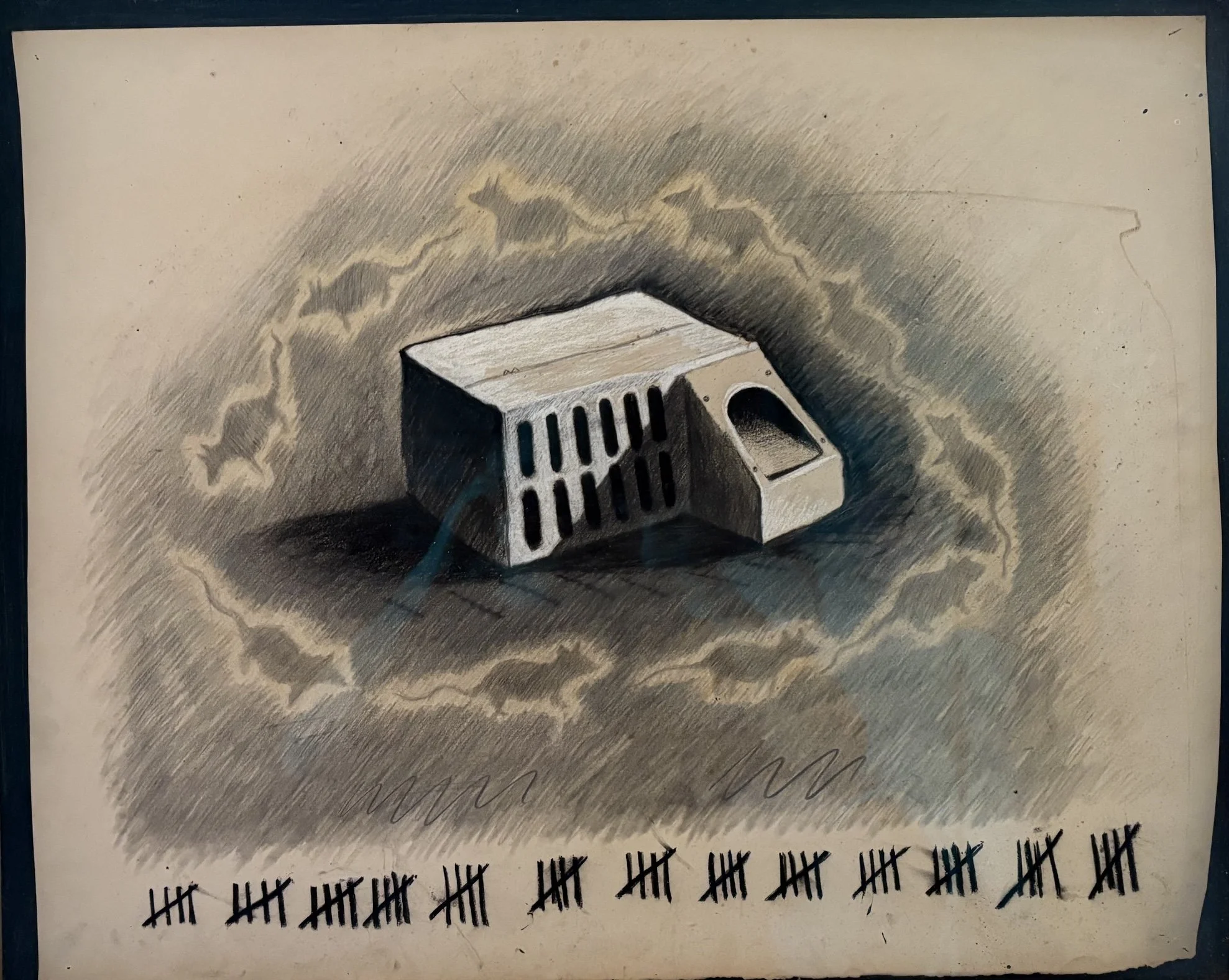
This drawing by my old pal Tom Ferris depicts a real thing, an antique mousetrap, which has much in common with the Freedom Tower.
HOBOKEN, NOVEMBER 22, 2026, On my couch, pre-dawn, usual position: legs outstretched, pen in right hand, notebook on lap, Nineteen Eight-Four mug from Penguin Books on table to my left.
When ideas don’t come, observe real things. Like the string of orange lights framing the sliding glass doors. I bought the lights from CVS for Halloween but now they’re for Thanksgiving and after that they’ll be for Christmas. I decide what the lights denote. The lights dispel the dark, whatever the season.
The dark outside the sliding glass doors right now isn’t dark-dark, heat-death dark. This dark is a presence, not an absence. It looks crisp, low-humidity. Cold out there, I’m guessing, not freezer cold but refrigerator cold. Check iPhone for exact temperature? Nah, I prefer to guess.
Lights line the Hudson’s far shore, casting wobbly columnar reflections on the dark water. Police SUV, red and blue lights flashing, prowls Pier A, spotlight probing the dark for homeless humans to torment.
Lights give darkness form. Or is it vice versa? Retrieve my battered Oxford Book of American Verse, remind myself what Wallace Stevens says. Yeah, riff on The Idea of Order at Key West like I riffed on Paterson or Waste Land.
But why write about an insurance executive’s century-old poem about Key West when I’ve got Hoboken right here before me in all its ho-hum glory? My current hometown seethes with epiphanies.
I spent the winters of 1973 and 1974 in the Florida Keys. Slept in a tent, snorkeled, puzzled over Idea of Order in American Verse, ate coconuts, hot dogs, baked beans. Life as a hippy left me with an abiding gratitude for bourgeois comforts. Hot showers, toilets, couches.
Is it possible to observe without remembering, comparing, interpreting? Kuhn says no. I reluctantly agree.
The Freedom Tower juts from the jumble of lesser towers in lower Manhattan. An upper block of floors appears fully illuminated. Those floors, I’m guessing, house heat and air-conditioning units. Water pumps. Generators. AI servers.
Speckled, haphazard lighting below denotes offices and cubicles in which humans toil, pondering screens bearing arcane symbols. Or maybe not so arcane, now that AI translates, dumbs down, explains for tiny human brains.
The Freedom Tower is a monument to American resilience! Or is it the resilience of American capitalism? No matter how much we have, we want more. More! That’s what makes Americans so formidable and yet endearing, our indomitable greed. We strive, we seek, we find, we do not yield until we launch an IPO.
Funny juxtaposition: To the right of the Freedom Tower, meaning right of the sliding glass doors, here in my living room, hangs Tom’s drawing of a ghostly structure circled by ghostly mice. Vicki finds the drawing “creepy.” I like it because it’s creepy. Here’s how I acquired it:
Last summer I visit Tom and Claudia in Brooklyn before their big move. Tom, my friend since our teens, is a carpenter and artist. His wife Claudia is an artist too, who also sells second-hand clothes. She’s Portuguese, and this year she convinced Tom to move to a house in the hills outside Porto, where she has family. That’s the big move.
I want to buy art from Tom before he and Claudia head to Portugal. I’m surveying the jumble of their living room—paintings, sculptures, antique clothes, antique tools, other odds and ends, emphasis on odds—when this drawing catches my eye.
I ask Tom how the image of the eerie structure came to him. In a dream? Weed or acid reverie? Tom points to a table on which sits the structure. It’s an old mousetrap, Tom says, which he spotted in an antique store years ago. It’s a real thing. As real as the Freedom Tower, although much smaller. Tom didn’t imagine it, he observed it.
I ask about the markings across the bottom. Are the mice counting off days they’ve spent in the trap? Tom puffs his cigarette, ruminates, exhales. That interpretation is interesting, Tom says through smoke, but he meant the markings to indicate how many mice have been trapped.
Oh, yeah, I say, duh.
Tom and I are old, in our seventies. Will I see him again? Sure, virtually, on WhatsApp.
Hoboken cops wake the homeless by shining a spotlight in their eyes. Dark blinds you, light blinds you, until you get habituated. Then habituation blinds you.
Back to the Freedom Tower. Traders in the tower are AI-enabled super-determined mini-machines whirring and clicking within the global AI-greased money-machine. Just as engineers extract energy from tidal ebbs and flows, so traders profit from paroxysms of Nvidia and Anthropic. The market’s free. Are we? Financiers are extensions of AI now, not vice versa.
Sure, financiers can leave the Freedom Tower, go back to comfortable homes in Tribeca, Scarsdale, New Canaan to sip Oban, watch Gilded Age, make love, sleep. But they’re prisoners all the same. They have no more freedom than the mice in Tom’s drawing.
Do Freedom Tower workers appreciate this irony? Even find it funny? A few, I’m guessing, do. They took humanities courses while pursuing finance degrees. They read Plato’s parable of the cave. They convinced themselves that knowing you’re in the cave is like escaping the cave.
If that thought doesn’t lift their spirits, the workers can glance out the window of the Freedom Tower and think, At least I’m not in Ho-Ho-Hoboken.
Vicki, when I tell her what I’m writing, frowns. She thinks I’m being mean, snobby, to Freedom Tower workers.
First: Oh! Blessed rage for justice, pale Vicki! Come on! If I can’t mock finance bros, who can I mock? Mocking the rich, like aspiring to be rich, is an American tradition. And it’s fun, one of those little things, like kisses and bon bons and hot showers, that make life worth living.
Second: I’m in the mousetrap too. We all are. The universe, even the multiverse, if it exists, is one big mousetrap. We’re born in it. We die in it. When we die, we leave behind a ghostly residue, a wisp of information that never dissipates, never vanishes. It remains in the mousetrap forever for recycling or whatever.
That’s what physicists say, and who am I to doubt physicists? Not even heat death will release us. At least our wisps are trapped with wisps of those we love.
And remember, if you know you’re in the mousetrap, that’s sort of like escaping.
Further Reading:
How Ho-Ho-Hoboken Became My Home
What’s Poetry’s Point? A Riff on “Paterson”
For more of this sort of thing, see also my work of autofiction, Pay Attention.