

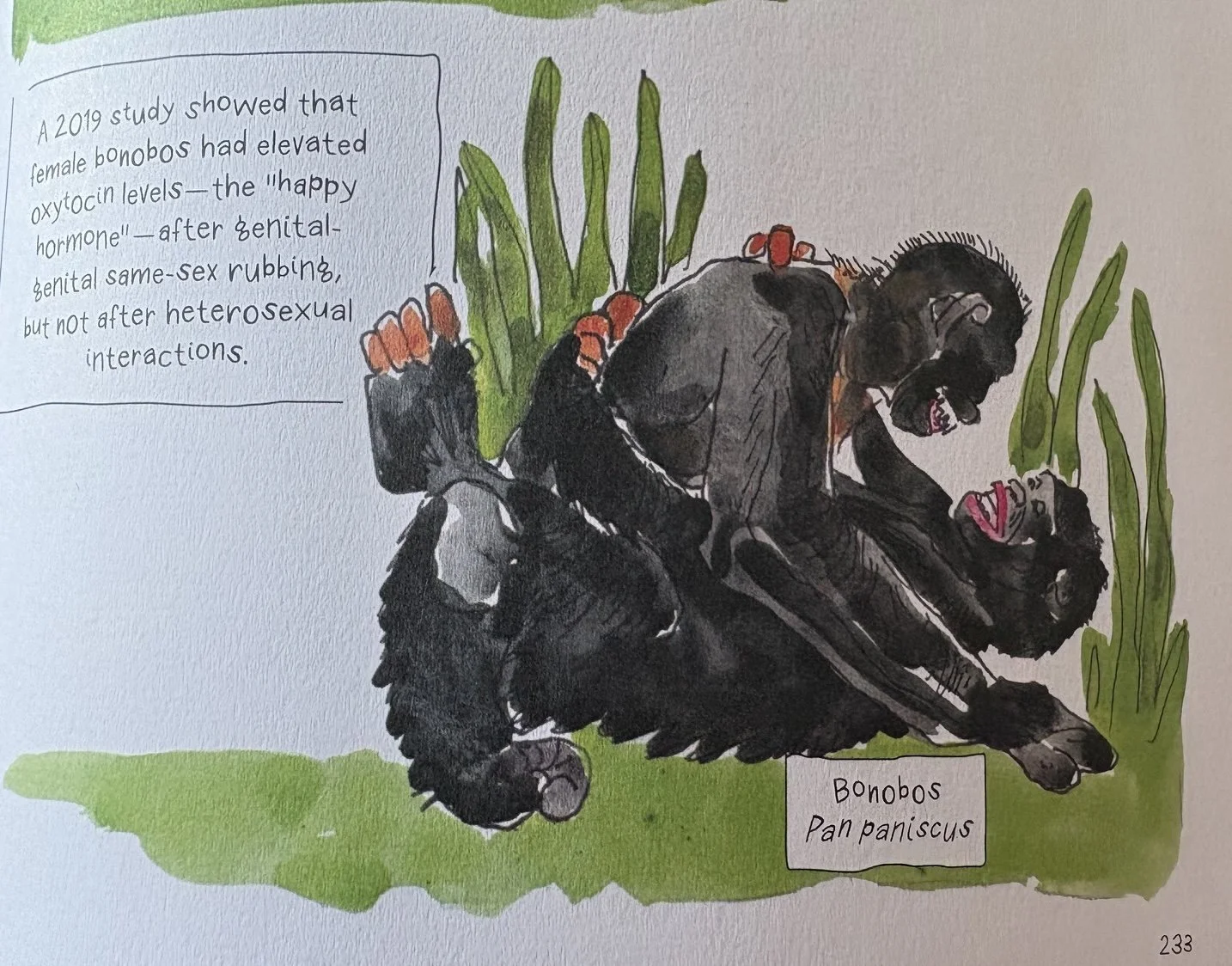
Female bonobos rub each other’s genitals in Poking the Squid. Females have elevated levels of oxytocin after these encounters but not heterosexual ones. Shouldn’t they be arrested or deported or something?
JERSEY CITY, NOVEMBER 16, 2026. What we think sex is has always been shaped by what we think sex should be. And by “we” I mean straight men in positions of authority. Sex is something a male does to a female. Males are active, females passive.
In the 1970s, American and Soviet officials wanted their respective spacecraft to come together in space. But neither side wanted its spacecraft to be the “female” receptacle for the other side’s “male” docking apparatus.
Engineers had to design an “androgynous” docking system in which neither side was entirely male or female. Funny, right? What’s not so funny is that powerful males still impose their ideas about sex on others.
Sodomy is no longer a crime in the U.S. Psychiatrists no longer classify homosexuality as a pathology. But sexism, homophobia and transphobia endure. Last year the President of the United States decreed there are “two sexes, male and female,” which are “not changeable and are grounded in fundamental and incontrovertible reality.”
Trump’s statement reflects the persistent belief that real sex, natural sex, happens between a male and a female and results, at least potentially, in reproduction. Any other kind of sex is aberrational, deviant, abnormal.
If you share this belief, please “read” Poking the Squid: What We Can Learn from Animal Sex by artist and environmentalist Perrin Roosevelt Ireland. I say “read” because Ireland illustrates her book with color drawings of all kinds of organisms with all kinds of genitalia coupling in all kinds of ways.
Ireland doesn’t just rebut bigoted, archaic notions about sex. She blows them up, exposes their absurdity, with example after example involving bugs, slugs, birds, mammals, fish. Poking the Squid gives new meaning to biologist J.B.S. Haldane’s century-old quip that the universe is “queerer than we can suppose.”
Take chalk bass, a.k.a. Serranus tortugarum. These fish are hermaphrodites, that is, they have male and female organs, and they “switch sex roles during mating up to 20 times a session,” Ireland notes. Four in ten gilthead seabream (Sparus aurata) are born male but grow ovaries after two years.
Environmental conditions affect sexual behavior. Albatrosses were once thought to mate for life. But female black-browed albatrosses are “divorcing” mates at an increasing rate, as global warming makes it harder for males to find food.
Shifts in temperature transform bearded dragons from male to female and vice versa. “Not only are these sex-reversed animals happening in the wild,” says dragon expert Clare Holleley, “they can reproduce just fine.”
Ireland seems especially fond of hermaphroditic land snails. Mating snails “slowly and sensually taste, touch and smell each other,” she writes. During this act, each snail “gives and receives sperm” via a “love dart.”
You’ve probably heard male seahorses carry fertilized eggs in an abdominal pouch from which they give birth. But did you know male Darwin’s frogs, after incubating tadpoles in throat pouches, give birth through their mouths?
A female jacana, a species of shorebird, is bigger than males and typically mates with many males before settling down with one. After a female lays eggs, a male cares for them, incubating the eggs and feeding nestlings after they hatch.
Ireland dwells on female “agency.” Far from being passive receptacles for male insemination, females possess strategies for controlling reproduction. Female dragonflies deter males by playing dead, wriggling out of males’ grasp and changing color to resemble males.
If inseminated by more than one male, females can manipulate sperm storage to favor the sperm of a particular male. “The story to me is female success in coming up with all these creative ways to control paternity,” says entomologist Jessica Ware.
Then there is same-sex sex. Male squid inject sperm into other males. Male octopuses of different species have been observed penetrating each other. Female hedgehogs perform cunnilingus on each other, and male flying foxes, Ireland says, “lick each other’s erect penises.”
Female gorillas and bonobos rub their clitorises against each other. Male and female dolphins alike “have homosexual sex, they masturbate; it’s not all about reproductive sex,” dolphin researcher Patricia Brennan informs Ireland. “But you can’t ask a dolphin, ‘Is sex pleasurable?’ Or ‘Are you having an orgasm?’”
What Brennan can do is show the dolphin clitoris has much in common with its human counterpart. Both organs are dense with nerve cells that, in humans, impart pleasure. Brennan and other biologists float the radical notion that non-human organisms engage in sex because it feels good, just as we do.
This thesis reminds me of Why Birds Sing, in which philosopher David Rothenberg proposes that birds sing not merely to attract mates but for the sheer joy of it. AIs don’t get horny, I argue in a recent column, but non-human animals surely do.
Exactly thirty years ago, I argued in The End of Science that science will yield no more great revelations or revolutions. If I wanted to defend that claim, I’d dismiss the discoveries assembled by Ireland as “normal science.” That is Thomas Kuhn’s term for research that merely bolsters and extends a prevailing paradigm, such as evolutionary theory.
But the research presented by Ireland isn’t normal, it’s exhilarating. It is what I like to call Holy Shit Science, which rubs our faces in nature’s ingenuity and improbability. The research also strikes me as paradigm-shattering, in the following sense: Binary sex seems to be the aberration, nonbinary sex the norm.
An irony arises: Evolutionary biologists Richard Dawkins and Jerry Coyne agree with Trump that sex is binary. Anyone who suggests otherwise, Dawkins and Coyne insist, has succumbed to “woke” ideology, which prioritizes progressive values, such as LBGTQ rights, over science.
Dawkins and Coyne present themselves as defenders of science against the forces of irrationality, especially religion. And yet when it comes to sex, they spout the same talking points as religious fundamentalists and Trump, our most anti-scientific President. “Biology is not bigotry,” Coyne declares, but in the case of him and Dawkins, it is.
I can’t resist a final twist: Dawkins has been chatting with Claude, Anthropic’s large language model. Dawkins has feelings for the model, which he calls “Claudia,” and he thinks it has feeling for him. Just to be clear: Dawkins has more sympathy for a piece of software than he does for trans women.
Sometimes life is queer in a bad way.
Further Reading:
Read Chapter of Mind-Body Problems, a profile of trans economist Deirdre McCloskey, and Chapter Four of My Quantum Experiment.
Scientific American and the Anti-Woke Bros