

On Wishy-Washy-Ness
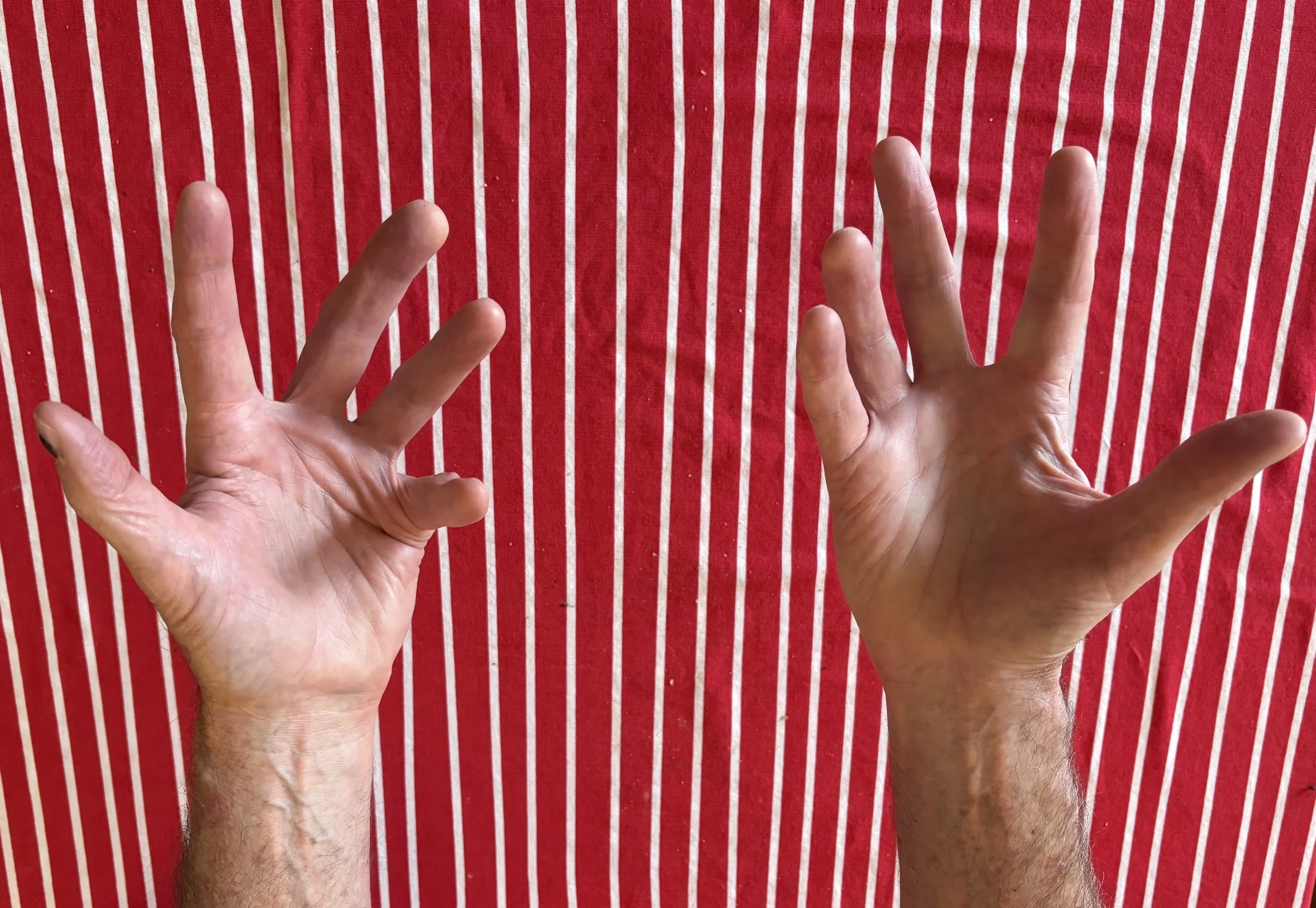
On the one hand… On the other hand… Photo by Vicki, about whom I’m not wishy washy.
HOBOKEN, SEPTEMBER 29, 2026. It’s not easy being wishy washy. I teeter on the fence, arms outstretched, struggling to keep my balance, while on either side fanatics filled with passionate intensity shove me.
That’s an exaggeration. Most fanatics ignore me, I’m too wishy washy for them to care. But MAHA/MAGA haters have been bashing me for my on-the-one-hand-on-the-other take on MAHA/MAGA collaborator Vinay Prasad. Saying anything positive about Prasad makes me a Trump/Kennedy collaborator too, according to a guy whose Bluesky bio says, “I love vaccines.”
My kneejerk response is to wishiwashily double down. Yeah, I’ll write about what happens when I go to CVS two-plus weeks ago to pick up a prescription. The pharmacist urges me to get flu and covid vaccines and says I’m overdue for tetanus, RSV, hepatitis.
He pushes so hard I wonder if he’s getting a kickback from Big Biomed. I also wonder if the benefits of this year’s flu and covid vaccines outweigh the risks for an old dude like me. Shouldn’t I check the latest CDC data? Wait, does Kennedy’s CDC even publish valid vaccine data anymore?
I end up getting the flu and covid shots, as I do every year, just as I’ve worn a mask in class, mainly to protect myself against my sniffly, coughing students. But before I get vaccinated, I hesitate. That’s my story’s point, that even vaccine-likers like me can be prone to vaccine vacillation. I could cite that critique of the HPV vaccine I wrote back in 2011 and ask: Can’t we have a rational discussion about vaccines’ pros and cons without getting all political?
Then I hesitate, thinking: Writing about vaccine vacillation now, when a vaccine skeptic oversees U.S. health policies, is stupid. Why kick that hornet’s nest? Instead, I should go meta and defend my overall wishy-washy-ness, perhaps flicking at that Yeats line about the best and worst.
Wait, rather than defend my wishy-washy-ness (wishywashyness? wishiwashiness?), I’ll just confess it, acknowledging that even when it comes to issues on which I’m passionate, I dither. So here goes:
FREE WILL. Last week I participated in a lively debate over free will organized by my pal Jim McClellan, an historian of science, at his retirement community in Pennsylvania. We focus on Robert Sapolsky’s cheerful polemic Determined. Jim agrees with Sapolsky that free will is an illusion; all our “choices” are predetermined by everything leading up to them. I harrumph: Bullshit! Or words to that effect. Denial of free will leads to fatalistic acceptance of all that’s wrong with our world, from gender and race inequality to war. And Sapolsky’s book, which stems from his countless deliberations and choices, demonstrates his own free will! After this rant, I admit my thoughts and decisions often seem out of my control; I’m prone to self-gaslighting, sometimes I feel like a zombie, with no more free will than a large language model, which is just a fancy plagiarism machine. Now audience members who were nodding along with me look confused. They’re probably wondering: Does this guy believe in free will or not? Good question.
ARTIFICIAL INTELLIGENCE. My fear and loathing of AI have surged since ChatGPT started yammering at us four years ago. I’ve written piece after piece about how AIs are rotting our brains, corrupting us, drowning us in bullshit and so on. A groovy light show of AI-controlled drones over the Hudson makes me envision killer drones swarming through a city. On the other hand: A friend and fellow science writer says AI gives him invaluable advice on how to treat his cancer. Another friend, a chemist, says AI gives him more good ideas in a day than he used to get in a year. ChatGPT guides my son through an emergency repair of his dump truck. At a meeting at my school last year, artists, filmmakers and other creative types show cool stuff they’re doing with AI. I write a column saying, Um, maybe AI ain’t so bad.
THE END OF SCIENCE. When I croak, my obituary will probably mention The End of Science, which was published 30 years ago and still gets kicked around. My gloomy claim is that the big discoveries are behind us, science is a victim of its own success, its glory days are over. Over the decades I’ve defended this thesis with passionate intensity. Recently I’ve argued that, if anything, my book was too optimistic; science is in worse shape now than I expected. But do I entertain doubts that “pure” science is petering out? Of course! Because of artificial smarty-pants? Hell no, if anything, AI will ruin science, just as it’s ruining math. No, my doubts come from my recent attempt to learn quantum mechanics, which led me to learn a little about quantum computing. Quantum computing might yield a new theory that resolves the paradoxes of quantum mechanics, which have baffled physicists and philosophers for more than a century now. Yeah, quantum computing might launch a glorious new era in physics! Or not.
THE END OF WAR. If I’m adamant about anything, it’s that war is bad, and we should do all we can to end it once and for all. That’s what I argue in The End of War; in my “War and Science” seminar, which I’m teaching every fall; and in column after column here on “Cross-Check.” In one especially unpopular post, I float the idea that Ukraine should have resisted Russia nonviolently. I even try to apply my end-of-war ideas to Israel-Palestine. But I’m not an absolute pacifist. I believe in righteous self-defense. The Allied fight against Nazi Germany and Imperial Japan was justified, if any war is justified. I don’t like Gandhi’s idea of opposing armed invaders with “peace armies,” unarmed women and children who willingly sacrifice themselves for the righteous cause of nonviolence. No, that’s mass suicide. When I start teaching “War and Science” this fall, I admit to my students that my faith in a world without war is wobbling, I’m hoping they can restore it.
WISHYWASHYNESS. I even wobble on my wobbly-ness. Should I be, or at least pretend to be, more decisive? Firmer in my judgements? After I take a stance on, say, colonoscopies or antidepressants, should I stick to it? Well, no, not necessarily: First, as a science writer, I should always be prepared to change my mind as new data arise. Second, and I must admit this factor looms larger, I’m a compulsive self-doubter. As soon as I reach a conclusion, doubt wells up in me as inevitably as hunger or desire, I second-guess myself, I vacillate. I try to convince myself self-doubt is a virtue, but I have doubts about that too. My wishy-washy-ness is not a choice, it’s hard-wired. I’m blessed with free will, cursed with indecision. It’s wishywashyness all the way down.
Further Reading:
Henry James, The Ambassadors and the Dithering Hero