

The Upside and Downside of Our Longing to Matter
Rebecca Goldstein says our yearning to matter “can bring out the best and worst in us.”
HOBOKEN, FEBRUARY 18, 2026. What an ingenious invention is God! A loving, all-seeing being watches over each and every one of us and remembers us, forever, after we’re gone. God also judges us. If we’re good, God lifts us up to heaven. If we’re bad, God hurls us down to…
Wait, forget that part, just stick to the loving, all-seeing part. Although your life might seem grueling and pointless, you matter to God. That should ease your pain.
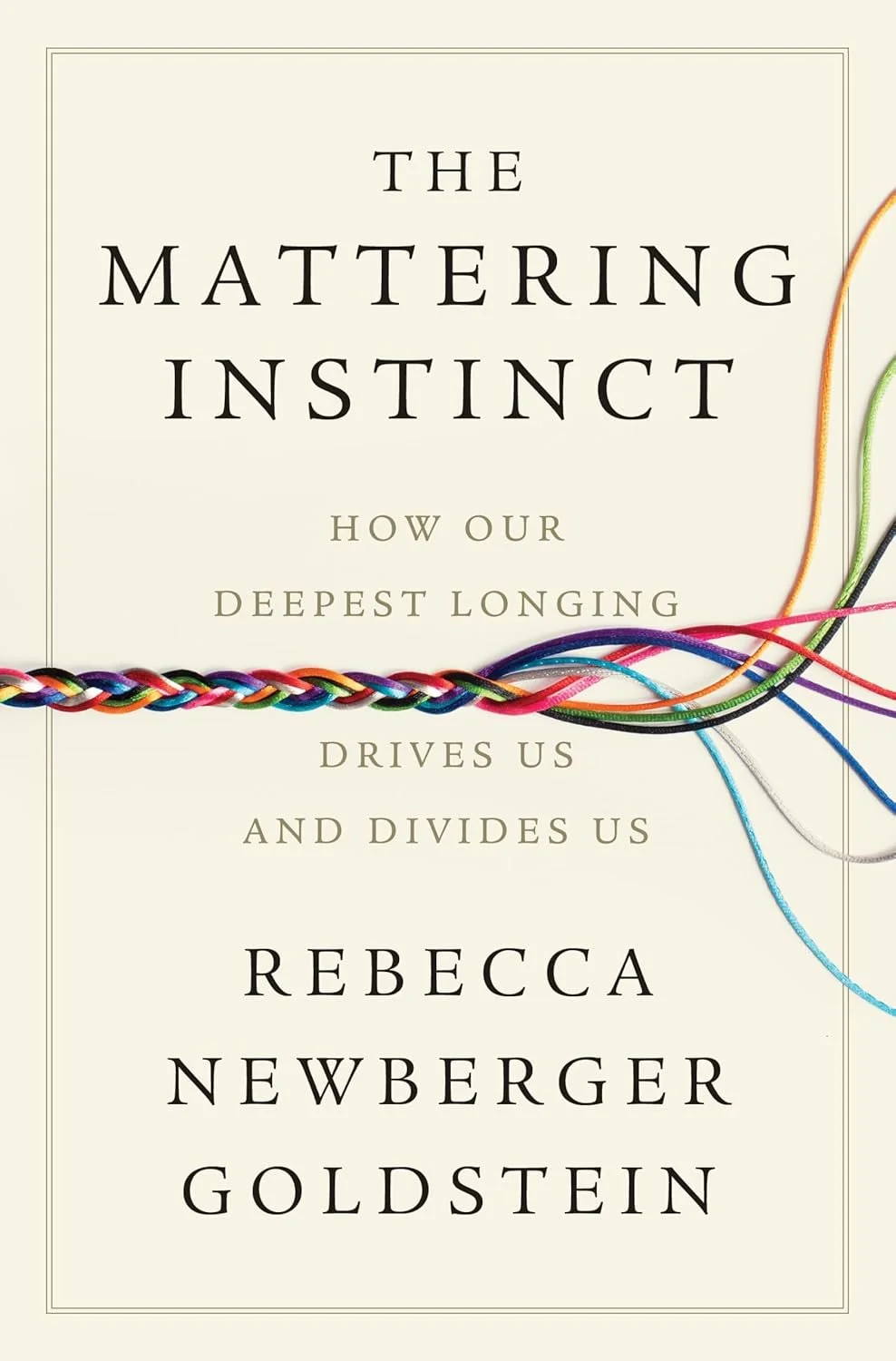
But what if God is dead or never existed? How, if at all, do we matter? Rebecca Goldstein wrestles with this age-old question in her timely new book The Mattering Instinct: How Our Deepest Longing Drives Us and Divides Us.
Goldstein, who explores philosophical ideas in fiction as well as nonfiction (her first book was The Mind-Body Problem: A Novel), is one of my favorite thinkers. See my profile of her here. I recently read Mattering Instinct and talked to Goldstein about it online before an audience at Stevens Institute of Technology. Below is my take on the book.
All organisms share the compulsion to survive and reproduce. But only we humans, Goldstein says, need to justify our existence, to convince ourselves that our life means something, it has value, it matters. We are matter that yearns to matter.
This innate drive, or instinct, has spawned religion and philosophy, the arts and sciences, politics and commerce--as well as warfare, slavery and all the varieties of human cruelty. The “longing to matter can bring out the best and worst of us,” Goldstein writes.
Goldstein is appealingly big-hearted and open-minded for a philosopher, and she writes with eloquent urgency. Raised in an orthodox Jewish home, she lost her faith while still a girl. She could not fathom how a just, loving God could allow the Holocaust and other atrocities to happen.
But unlike prominent philosophers and scientists, Goldstein doesn’t disdain believers. Her childhood left her with an affection for religion. Life is hard, you are entitled to believe whatever helps you cope--as long as your belief doesn’t result in harm to others.
Goldstein derives pleasure and meaning from the pursuit of truth, via science (she studied physics and math), philosophy and literature. But she rejects the claim that truth-seeking is the supreme human endeavor. The search for truth “is certainly the best thing I can do with my life,” she says in our conversation. “It has made my life worth living. But it’s not for everybody.”
Mattering Instinct celebrates the wildly diverse ways, or “mattering projects,” in which humans find fulfillment. Goldstein made me reflect on callings of people close to me: arborist, screenwriter, chocolatier, poet, horse trainer, meditation teacher, historian…
Our reasons for choosing mattering projects are subjective, like our tastes in food or music. You dig Sinatra, I prefer Hendrix. But that doesn’t mean all mattering projects are equal. “I try to distinguish between better and worse ways of going about this need to justify ourselves,” Goldstein says.
The second law of thermodynamics, she proposes, can provide a way to evaluate mattering systems. The second law says entropy always increases over time. Entropy is often equated with “disorder,” but I prefer to think of it as lifelessness, blandness, boringness.
The most boring state is heat death, which the second law says is our ultimate cosmic fate. Everything is cold and dark, nothing can happen, which means time itself ceases. Heat death is death on a cosmic scale, it annihilates meaning.
The second law, Goldstein proposes, can help us rank mattering projects. Those that foster life, creativity, diversity, happiness are good, because they help us resist the pull of entropy.
Projects that foment hatred, conflict, oppression and violence are bad, because they accelerate our descent toward heat death. Eugenics, Social Darwinism and fanatical religious and political ideologies come to mind.
“You can’t deduce an ought from an is,” Goldstein warns. But the second law “captures our moral intuitions, that there are some better ways to appease this longing to matter than other ways.”
Above I call Goldstein’s book “timely.” Why? Well, over the past few centuries, many societies have rejected, at least in principle, the idea that some people matter more than others. The U.S.. and other nations have taken steps to reduce life’s unfairness, so more people have a shot at happiness.
But ideologies that treat mattering as a zero-sum game, with winners and losers, have come roaring back. The more I matter, the less you matter. Men matter more than women, whites more than people of color, Christians more than Muslims. We are chosen, you are damned. You matter more if you’re strong, beautiful, smart, successful, rich. Especially rich.
If there is a global ideology now, it’s capitalism, which reduces worth to wealth. Capitalism has “filled the vacuum” left by the decline of religion, Goldstein says. Even “communist” China has embraced capitalism.
It is “the very, very rich who matter, the powerful, the famous,” Goldstein elaborates. “So it just leaves the majority of mankind feeling like nothing. And that is intolerable.”
Tyrants like Trump and Putin are increasing entropy “on a very historic level,” Goldstein adds. “There is a tremendous amount of suffering going on right now,” because our institutions “are not holding up against the power hungry.”
At the end of my conversation with Goldstein, I point out that many people are frightened now by the rise of authoritarianism and other perils: climate change, artificial intelligence, civil unrest, war. I ask if she has advice for those struggling with fear and despair.
Goldstein takes heart from the fierce determination of all living things to resist the second law. “That fuels me,” she says. “It strengthens me.” She views our species, flaws and all, as “wondrous,” worth preserving, worth fighting for. “I do not want our species to end, and I want us to put up a good fight.”
“All people of good faith should somehow be in contact with each other. We need to give each other strength,” she says. “Fight. Give me a leader who will show us how to do this, and I will get behind them.”
Further Reading:
Entropy, Meaninglessness and Miracles
Free Will and the Sapolsky Paradox
Can Physics Ease the Sting of Death?
India and the Unfairness Problem
See my profile of Goldstein in Mind-Body Problems. And for more of my thoughts on social progress, see chapter nine, “A Pretty Good Utopia.”