

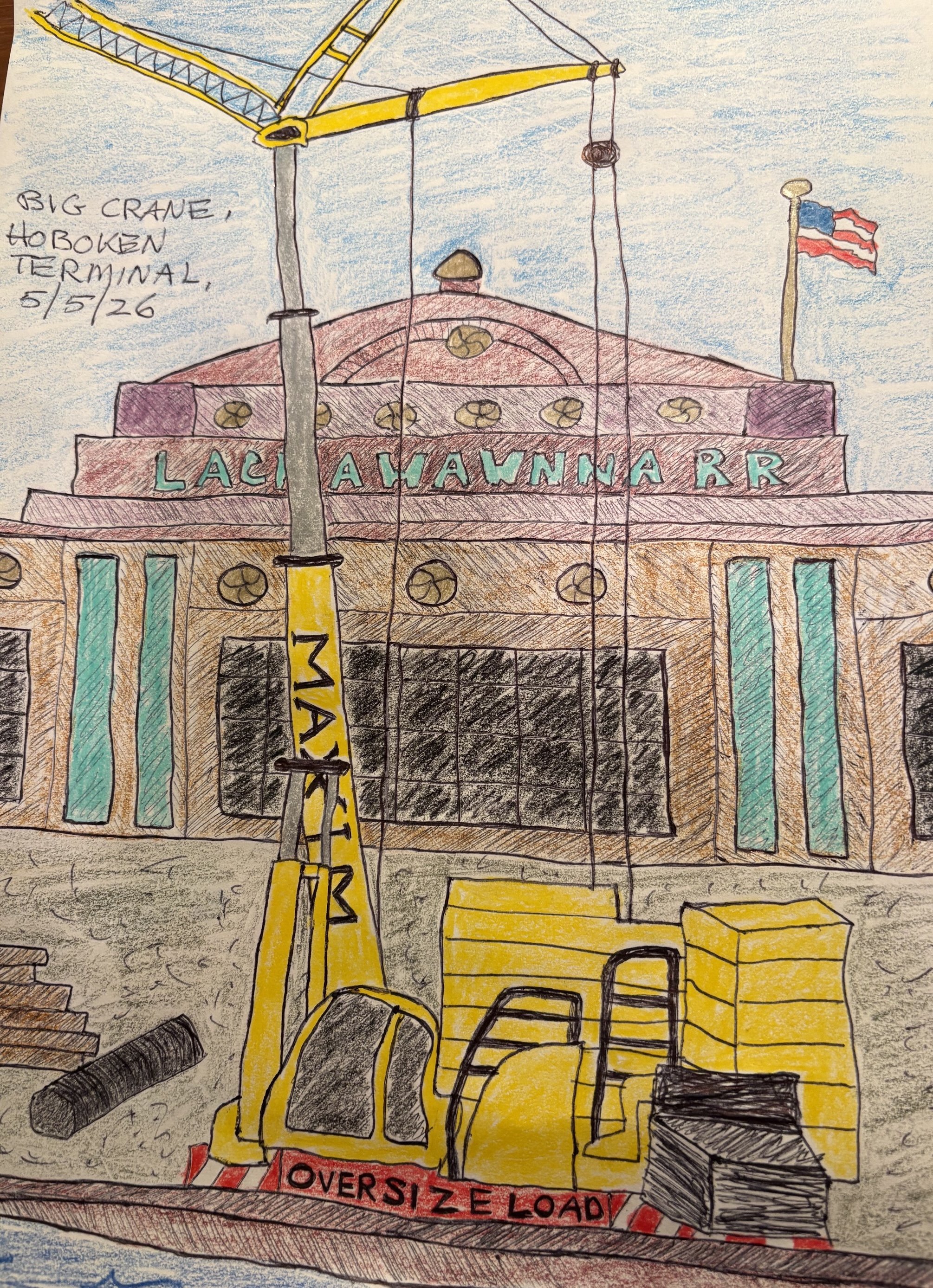
You have to know what you’re doing to operate a crane like this.
HOBOKEN, MAY 15, 2026. “Where on earth did you come across that ‘Dream of the Fisherman's Wife’?,” Jim emails me after reading my column on the “fluidity” of sex and love. “Perhaps the most erotic piece I've ever seen! I'm going to make it my screen saver!”
Jim adds: “Check out the word ultracrepidarianism. Wonderful for commenting about all the stuff posted out there about which one really doesn't know shit.” He goes on to offer thoughts on sex and love.
I google ultracrepidarianism, which is new to me. The word has a cute origin story, involving a painter, a sandal-maker and a 19th-century British essayist. As Jim says, it means opining on things outside your “area of expertise.”
Jim is indulging in false modesty when he calls himself an ultracrepidarian. He’s a wise old man, with abundant first-hand knowledge of sex and love. That’s far more important than scholarly expertise.
Jim’s also an historian of science, who knows a lot more than I do about a lot of science-y stuff. I suspect Jim, who’s a mischievous guy, a teaser, is insinuating that ultracrepidarianism applies more to me than him.
If so, I embrace the insinuation, because Jim is right. Ultracrepidarianism has been my career path. I’ve made a living opining on topics in which I lack expertise.
Some science journalists have science degrees. Not me. Although I took a few science courses in college, I majored in literature and then got a master’s in journalism. I became a science journalist in the early 1980s because existence baffles me, and science offers our best hope for illumination. I hoped to explain scientists’ discoveries to the public and thereby to myself.
Some scientists, I soon discovered, exaggerate and obfuscate when presenting their work. Plus, scientists disagree with each other. Who’s right, who’s wrong? My job, I decided, should be to adjudicate these disputes by distinguishing legitimate scientific claims from bullshit.
I don’t trust experts simply because they’ve got fancy credentials, like a Ph.D. and tenure at an Ivy League school. Nobel Prizes? Pshaw. I trust experts because what they say makes sense to me, it stands up to scrutiny.
Personality matters. I trust experts who seem open-minded, willing to admit they might be wrong. I distrust those who strike me as arrogant, committed to foregone conclusions. If I like or dislike an expert, that affects my judgement, but only so much.
I wrote snarky profiles of prominent scientists for Scientific American. I called Edward Witten “The Pied Piper of Super Strings,” Murray Gell-Mann “The Lonely Odysseus of Particle Physics,” Francis Crick “The Mephistopheles of Neurobiology.”
I reported on investigations into big mysteries. Origin of the universe, origin of life, consciousness, the meaning of quantum mechanics. I began to suspect these mysteries might be unsolvable.
I even held forth on mathematics. In my 1993 article “The Death of Proof,” I proposed that the increasing complexity of mathematics, plus mathematicians’ growing reliance on computers, were rendering traditional proofs obsolete.
My ultracrepidarianism provoked pushback, and not just from scientists and mathematicians. The editor of my first book, whom I’ll call Patrick, urged me to keep my opinions to myself. Readers, Patrick assured me, want to know what the scientific bigshots you’ve interviewed think, not what you think.
I snapped: It’s my book, I’m gonna say what I wanna say. Or words to that effect. There are lots of books in which journalists let scientists pontificate, I pointed out to Patrick, what sets my book apart is that I pontificate, too.
Fine, Patrick said, and handed my book off to another editor. Patrick probably thought my book would flop, and he wanted someone else to take the blame. My new editor, Jeff, liked my ultracrepidarian style. Jeff signed off on my book, and Addison-Wesley published The End of Science exactly 30 years ago.
I have no regrets. Pundits are still batting around my views on science’s limits. A few have grudgingly conceded that maybe I was onto something. This week I defended The End of Science to the Amateur Astronomers Association of Princeton, and the talk seemed to go pretty well.
But I need to comment briefly on ultracrepidarianism. It is a perilous path, which can be navigated poorly or well. I like to think I’m a competent ultracrepidarian. I do lots of research before challenging the expert consensus on, say, colonoscopies or theories of consciousness.
I trust many experts—for example, climate scientists who say fossil-fuel consumption is pushing global temperatures higher. That consensus strikes me as sound. Rock solid.
A premise of The End of Science is that scientists have gotten many things right, so much so that science has become a victim of its own success. Paradigms such as evolution by natural selection, DNA-based genetics, the big bang and the atomic theory of matter persist because they are true, and they can only be discovered once. Scientists have constructed a picture of the world so robust that there may be no more “revolutions or revelations,” as I put it.
That’s my ultracrepidarian view, anyway.
The problem with second-guessing experts is knowing when to stop. You might reject experts simply because they’re experts, which is dumb. You might retreat into radical skepticism, doubting all knowledge claims. You might tumble into conspiracy-theory wormholes.
In our era, stupid ultracrepidarianism reigns. The internet makes it easier for idiots to outshout experts. Cruel, arrogant ultracrepidarians have risen to positions of great power, which allows them to ram obfuscations, exaggerations and lies down our throats.
It’s hard for me to see a solution to the ultracrepidarian problem. AI hype-master Sam Altman will no doubt insist that “superintelligent” AI can solve the problem by distinguishing fact from fiction, truth from bullshit. But AI, by empowering the worst kinds of ultracrepidarians, is compounding the problem.
“Was ‘The End of Science’ Too Optimistic?” That’s the title of the talk I gave in Princeton Tuesday night. I said the replication crisis, Epstein scandal, surge of AI and ascent of Trump make me even more pessimistic than I was when I wrote The End of Science.
I’m not just worried about the future of science, I told the amateur astronomers, I’m worried about the future of civilization, which makes science possible. I didn’t mention ultracrepidarianism, but I had it in mind.
A high schooler in the audience asked if he should give up his dream of becoming an astronomer. Grimacing, I replied: No, pursue your dream, I’m probably being too gloomy.
Further Reading:
The End of Science, 2015 edition
Huge Study Confirms Science Ending! (Sort Of)
My Doubts about The End of Science