

Truman, The Bomb and Free Will
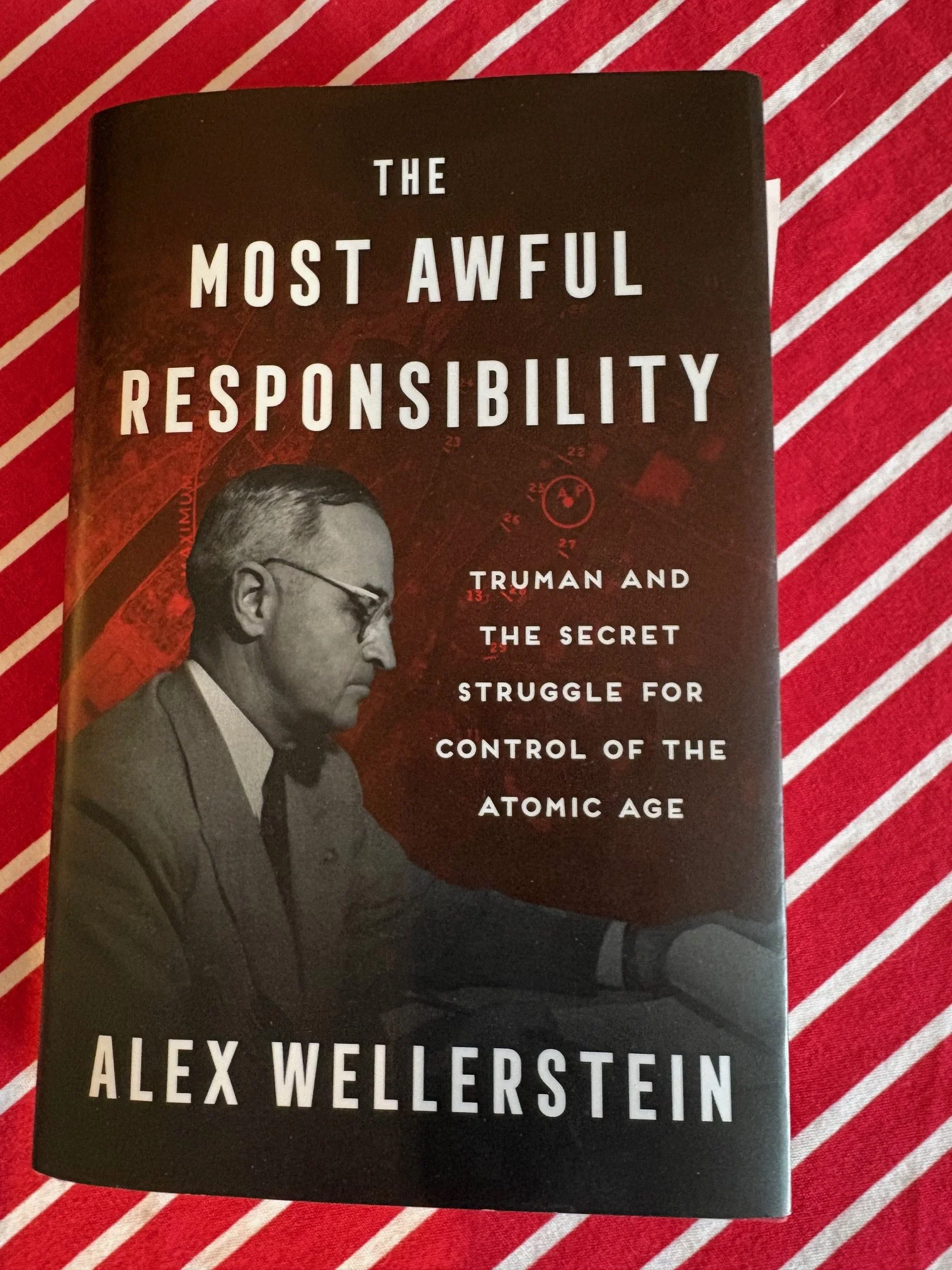
You should read this book.
HOBOKEN, MARCH 14, 2026. A friend’s book has me doubting, once again, whether we have free will. Which means I’m doubting whether we can end war before it ends us.
Thanks a lot, Alex.
The book is The Most Awful Responsibility: Truman and the Secret Struggle for Control of the Atomic Age by historian of science Alex Wellerstein, my colleague at Stevens Institute of Technology. Alex, now on leave in Paris (as you’d know if you read his blog Doomsday Machines), just gave a zoom talk to Stevens about his book.
Awful Responsibility details Harry Truman’s “decision” to drop atomic bombs on Japan in August 1945 and his subsequent “decisions” involving nuclear weapons. I wrap “decision” in scare quotes because…
Let me back up a moment and say what I mean by free will. I see it as our capacity to discern different options and weigh the pros and cons of each before deciding on one. This capacity is especially crucial for making decisions with moral implications. Like, say, dropping a nuclear bomb on a city.
Meaningful free will, the kind worth having, requires some knowledge of and control over your circumstances. Truman gained as much control, in principle, as any man alive when he succeeded Franklin Roosevelt as President on April 12, 1945.
But Truman was often uninformed. Only after Roosevelt’s death did Truman learn about the Manhattan Project--in a 45-minute briefing!--and his knowledge remained sketchy. When he met Stalin in the rubble of Germany in late July 1945, Truman revealed that the U.S. had built a “new weapon of unusual destructive force,” as he wrote in his memoir.
Stalin reacted mildly to this disclosure, because, Truman assumed, the Russian tyrant didn’t understand the atomic bomb’s significance. Actually Stalin, because of his “extensive espionage networks,” Alex writes, learned about the Manhattan Project “years before Truman did.”
Truman’s advisors—notably Harry Stimson, the Secretary of War, and General Leslie Groves, who oversaw the Manhattan Project--weren’t always straight with him about how the atomic bomb would be used. At Stimson’s urging, and against Groves’s wishes, Truman ruled out dropping a bomb on Kyoto, a city renowned for its beauty.
Truman thereby assumed, wrongly, that the U.S. was going to target military bases, to avoid civilian casualties. He was therefore shocked to learn that the bombs dropped on Hiroshima and Nagasaki had killed tens of thousands of civilians—“women and children,” as Truman put it.
Truman didn’t want that to happen again. That’s why he resisted his generals’ demands to give them control over nuclear weapons. Truman put a civilian agency, the Atomic Energy Commission, in charge of the weapons. And he insisted that only the President could decide whether to use the weapons again.
But pressured by hawks like Edward Teller, Truman did not stop scientists from inventing fusion bombs a thousand times more powerful than the fission bombs dropped on Japan. Truman reluctantly accepted that the Soviet Union, which tested its first fission bomb in 1949, would probably build fusion weapons, too, so America better build them first.
“It is not an easy thing to order the development of a weapon that will kill ten million people,” Truman confided to a colleague. And yet that is what he did. Truman also began ceding control of nuclear weapons to the military, a trend that accelerated under Eisenhower.
Truman, whose slogan was “The Buck Stops Here,” always took responsibility for Hiroshima and Nagasaki. And yet, Alex argues, those bombings stemmed from “an accumulation of smaller decisions, as well an assumption made by nearly everyone involved in the planning that the weapons would be used.”
The same could be said of “decisions” that propelled the nuclear arms race, which by the late 1950s threatened humanity with annihilation. Awful Responsibility makes me suspect that, if you examine any Presidential “decision” closely enough, you end up lost in an infinite regress of possible causes.
Alex resists grand philosophical pronouncements. But he does warn that “people are always, at least in my experience, fundamentally unknowable, even to themselves.” This acknowledgement of the limits of knowledge reminds me of two other works of which I am a fan:
One is the 2003 documentary The Fog of War, Errol Morris’s Academy-Award winning portrait of Robert McNamara. A Harvard-trained efficiency expert, McNamara helped design the plan to firebomb Japanese cities toward the end of World War II.
Later he served Kennedy and Johnson as Secretary of Defense during the Vietnam War. In Fog of War, McNamara comes across as a decent, rational man who nonetheless participates in horrific acts.
That’s how I see Truman, too, after reading Awful Responsibility. Alex calls Truman “earnest, humane, and deeply unsure of the right path forward, frequently making difficult decisions with limited foresight, but tending to hew to values that are fairly admirable in their nature.”
One of those values is that incinerating children is wrong. And yet Truman, like McNamara, did just that. Alex’s book and Morris’s film both convey the same message: War makes good people do bad things. War turns men into monsters. (Not surprisingly, Morris loves Alex’s book.)
Awful Responsibility also brings to mind War & Peace, Tolstoy’s novel about the Napoleonic wars. In an addendum, Tolstoy argues that free will is an illusion. Even someone as powerful and seemingly “free” as Napoleon, Tolstoy asserts, is buffeted this way and that by social forces beyond his control and comprehension; a single person has as much influence over history’s trajectory as a drop of water has over a waterfall.
Awful Responsibility corroborates Tolstoy’s fatalism. Or so I think as I finish Alex’s book, shortly after the U.S. and Israel launch their war on Iran. As American and Israeli bombs rain down on AI-selected targets, including a school for girls, I’m in a grim mood, fearful about where humanity is headed.
But Alex, during his Zoom talk on Wednesday, lifts my spirits. After he finishes lecturing on his book, I ask if he agrees with Tolstoy that free will is an illusion. Alex says he understands why Tolstoy, and many modern historians, see us as pawns of nationalism, capitalism, industrialization and other vast social forces. Alex certainly doesn’t buy the idea that the decisions of “great men” determine history’s course.
He nonetheless thinks individuals can make a difference, for ill and good. He doesn’t like any perspective that lets Hitler “off the hook.” If Hitler had never been born, would Germany have become so malignant in the 1930s?
Conversely, if Truman hadn’t been President, the 20th century might have been even bloodier. In his book, Alex calls Truman “the most important anti-nuclear President of the twentieth century.” Under other leadership, Alex tells me, the United States might have used nuclear weapons during the Korean War, triggering World War III.
This is just the message I need to hear. Yeah, no one, not even presidents and emperors, has absolute free will, any more than anyone has absolute knowledge. And yet through our decisions, however benighted and imperfect, we can surely nudge the world away from the insanity of war, including nuclear war. Alex’s response to my question gives me hope in this dark time.
Thanks, Alex.
Further Reading: