

Pynchon, Thanatoids and the Ferris Wheel of Life
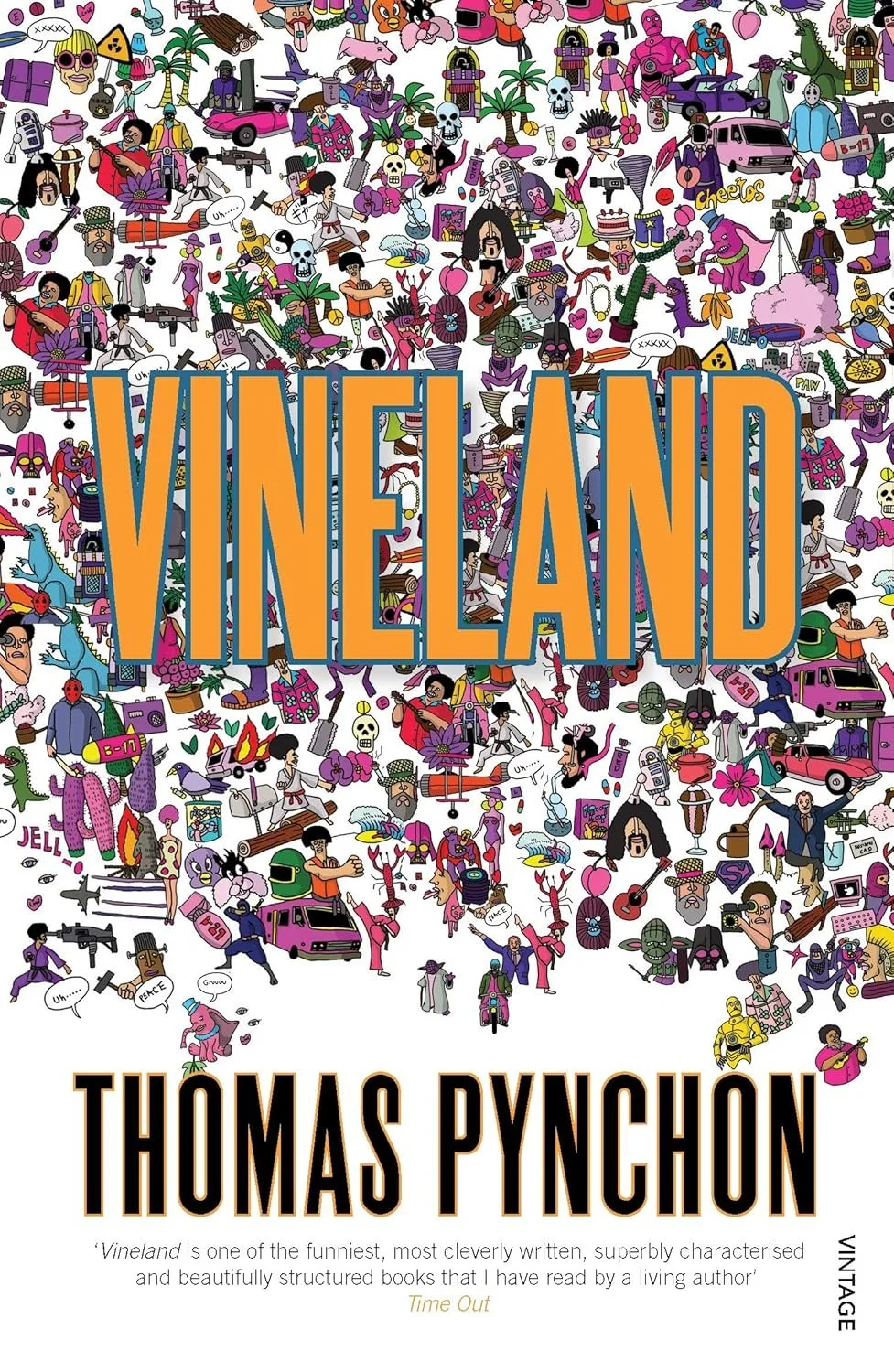
This cover captures the chaos of Pynchon’s 1990 novel, but the central plot is just a love triangle.
HO-HO-HOBOKEN, DECEMBER 11, 2025. I stand under a black, starless sky watching a Ferris wheel turning, turning. The wheel’s bedazzled perimeter and spokes make the surrounding darkness darker. I can barely see the passengers going up and down, up and down, but I hear their shrieks.
This trippy youthful vision comes back to me as I read Thomas Pynchon’s 1990 novel Vineland. It’s set in California in the mid-1980s, when Reagan reigned, but it gazes back at that mythological epoch The Sixties, for which I feel proprietary fondness.
You remember The Sixties, right? Vietnam, flower children, Hey Hey LBJ, Woodstock and Altamont, Zap Comix, JFK and MLK and RFK, Leary, the Chicago Eight, Nixon, Weathermen and Black Panthers, Hendrix and Morrison and Joplin, Kent State, The Mod Squad.
Normally pundits invoke The Sixties to pass moral judgement: It was a time of noble idealism from which much goodness flowed! No, it was a period of dopy degeneracy that continues to corrupt us! That sort of thing.
For Pynchon, The Sixties are a zany clown show that transcends petty notions like “good,” “evil” and “progress.” But then, that’s how Pynchon depicts World War II, too, in Gravity’s Rainbow. Life is a circus.
The opening scene of Vineland establishes the goofy tone: Retired revolutionary Zoyd Wheeler crashes through the window of a bar as TV cameras roll. Zoyd performs this ritual annually, it turns out, to prove he’s nuts and hence eligible for disability benefits.
Like Gravity’s Rainbow, Vineland (named after the hippy hamlet where Zoyd has holed up) has a manic pinball vibe, lots of flashes, beeps and boops. It’s tough keeping track of all the characters careening back and forth. But the plot comes down to a simple love triangle, each node of which (and pardon the lit-crit reductionism) represents a key component of The Sixties:
Frenesi Gates is a hard-assed free spirit and rebel, a stand-in for the Weathermen, Symbionese Liberation Army and other jackasses who sought to topple Amerika with bombs and bullets.
Zoyd Wheeler dabbles in armed rebellion after he falls in love with Frenesi, but his heart isn’t in it, he’s a lover not a warrior. He embodies the turn-on-tune-in-drop-out side of The Sixties, which never really clicks with the neo-Leninist schtick.
Brock Vond is a hard-assed federal agent intent on crushing the counterculture by tracking down and busting revolutionaries and dopers. He signifies fascism, the police state, anti-drug and anti-commie hysteria, straight culture, Just Say No, The Man.
The sex in Vineland isn’t nearly as graphic and polymorphous as in Gravity’s Rainbow. But once again desire serves as a randomizing force, which keeps the chaos churning. Meaning that Frenesi and Brock, the outlaw and cop, have the hots for each other.
After Brock captures Frenesi, they have wild sex, and he gets her to betray her former comrades. Pynchon’s not-exactly-original-but-bears-repeating point is that zealots of the left and right have lots in common. They share fantasies of dominance, of imposing order on an unruly world.
The counterpoint to these control freaks is Zoyd, a hapless everyman who reminds me of Crumb’s Flakey Foont or the Coen brothers’ Dude. Zoyd just wants to chill, keep on truckin’, smoke a doob and watch the world go round. But he bears a big responsibility: raising the daughter he (or maybe Brock?) conceived with Frenesi before she vanished underground.
Two other subplots--subthemes?--of Vineland deserve mention. Make that three, which, like everything in Pynchon, are related, sort of. One involves Thanatoids, who wander through the action as ghosts, or zombies, neither dead nor alive. Is Pynchon toying with the idea, proposed by Daniel Dennett and Douglas Hofstadter, that none of us is truly conscious?
Then there is The Tube, meaning Boob Tube, meaning television, a ubiquitous background presence in Vineland. The Tube reduces everything, including the counterculture, to a commodity, entertainment. Like The Mod Squad! Clever capitalists turn us all, including the rebels, into screen-addicted zombies. Thanatoids! Pynchon eerily anticipates our era’s exponentially more potent technologies of mass manipulation. We’re all Thanatoids now.
The third subplot, or subtheme, involves the Sisters of Our Lady of the Cucumber Patches, ninja nuns who occasionally carry out assassinations. Yeah, nothing is sacred, everything’s a laugh riot. Could Pynchon’s cucumber-loving (snicker) sisters have inspired the Netflix series Warrior Nuns?
Vineland definitely inspired Paul Thomas Anderson’s new film One Battle After Another. My quick take: One Battle is action-packed, funny, poignant, I enjoyed it. But it makes Pynchon’s cartoony characters even more cartoony. And it reduces the novel to a mawkish message about the politics-transcending love of a dad for his daughter.
I’m susceptible to this message, I have a daughter. But whatever else you can say of Pynchon, you can’t call him mawkish. He’s cold, or rather, mischievous. He’s a smirking trickster, a carnie magician, a master of irony and sleight of hand, whom you should never take at face value.
But in one passage of Vineland, Pynchon, speaking through Frenesi, seems to pull back the curtain and give us a glimpse of how he really sees things. We’re nothing more than digital programs, he muses, being manipulated by “an angel, a minor god, something in a UFO” tapping “keys on alphanumeric keyboards.” Pynchon continues:
We are digits in God’s computer… And the only thing we’re good for, to be dead or to be living, is the only thing He sees. What we cry, what we contend for, in our world of toil and blood, it all lies beneath the notice of the hacker we call God.
Here Pynchon presages the Simulation hypothesis, espoused by the likes of Bostrom, Musk and deGrasse Tyson, which holds that our “reality” is a computer game made by a nerd-deity. Pynchon floated the notion that reality is digital as far back as 1966 in The Crying of Lot 49, according to this online chat.
Wait, this just occurred to me: If living and dead humans are ones and zeros in a divine simulation, then maybe Thanatoids, who like Schrodinger’s cat are both alive and dead, give god’s computer a quantum boost.
Anyway, if there is a collective unconscious, Pynchon owns a box seat in it.
There’s a kind of consolation in Pynchon’s perspective. It resembles a Hindu cosmology or multiverse theory that makes our grand human adventure seem a fleeting thing, a sparkle in the dark. The moral dramas that embroil us—during World War II, The Sixties, our excruciating moment--fade into insignificance. If you stand back far enough, shrieks of terror and ecstasy sound the same.
This world is an amusement-and-pain park. The wheel of fortune spins us round and round, and where it ends, if it ends, no one knows, not even Pynchon, the mad hacker furiously tapping his keyboard.
Further Reading: