

Brain Chips Can Prevent War and Lovers’ Spats
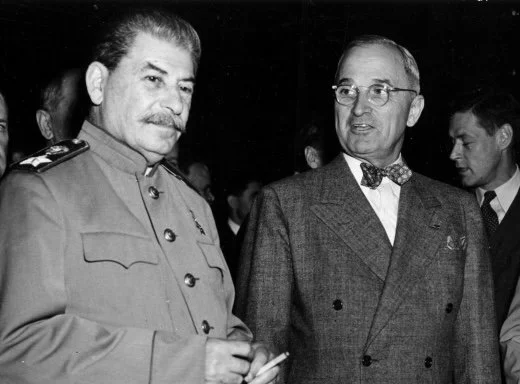
If these guys had brain chips, maybe they wouldn’t have started the nuclear arms race.
HOBOKEN, APRIL 1, 2026. It’s a brute fact of the human condition that you can’t be certain—you can’t really know--what’s going on in anyone else’s mind. Not your girlfriend’s, not Stalin’s.
Let’s start with your girlfriend. When she says she loves you, you’d like to believe her, but your romantic history gives you pause. Women change their minds, they fall in and out of love, they dig more than one guy. Yada yada.
Also, your girlfriend might want to love you, she might think she loves you, but does she really? She’s always been straight with you, honest, but how well does she know her own mind? We gaslight ourselves as well as others.
The same is true of you. And by “you” I mean me. If I’m honest, I must admit I’ve felt doubt, at least now and then, about every woman I’ve loved. Love, for me, is an unstable, volatile condition. Even, especially, at its best, its most magical, love surges and ebbs, ebbs and surges.
A graph of love’s ups and downs might yield twin squiggles, like the real and imaginary sinewaves that tell you where you might find a quantum particle in a box. The wave made of imaginary numbers (based on the square root of negative one) tracks your love, the real-number wave your doubt.
Wait, maybe it’s the other way around, your doubt is imaginary, your love real.
Either way, romantic uncertainty stems from what I call the solipsism problem, the inability of anyone to truly know anyone else. The solipsism problem makes love thrilling, a risky foray into the unknown, but it also explains why romantic love often ends badly, in betrayal, bitterness, heartbreak.
You fear being a naïve, deluded fool, so you convince yourself your doubt makes sense. It’s prudent. Your girlfriend senses your doubt, which makes her doubt you. In this way, lovers’ doubts escalate and become self-fulfilling, ruining a good thing.
That brings me to Truman’s fraught relationship with his frenemy Stalin. I recently read The Most Awful Responsibility: Truman and the Secret Struggle for Control of the Atomic Age. Historian Alex Wellersein examines how Truman, President from 1945 to 1953, shaped the nascent nuclear-arms race between the U.S. and Soviet Union.
Truman was surprised and horrified that the bombs dropped on Hiroshima and Nagasaki killed tens of thousands of civilians. He hoped nuclear weapons would never be used again. When Stalin, our World War II ally, assured Truman in 1945 that he wanted peace too, Truman was desperate to believe him.
Then in 1949 the Russians detonated an atomic device, and Truman realized Stalin had spied on the Manhattan project and stolen our bomb design. Truman was upset, he felt the commie tyrant had snookered him.
Truman reluctantly accepted that Stalin couldn’t be trusted. Prudence dictated that the Americans, to protect themselves against the Russians, should build more bombs. Many more, including fusion bombs thousands of times more potent than the fission bombs dropped on Japan.
The Russians, mirroring the Americans, built an enormous nuclear arsenal of their own. Before long the two nations amassed enough nukes to destroy humanity many times over. All because of the solipsism problem.
Last October I observed a debate, sponsored by National Public Radio, on the question, “Is War Inevitable?” Gabrielle Rifkind, a conflict mediator, said no, war is not inevitable. Her main point was that war is a shitty and avoidable means of resolving disputes.
Political scientist Dylan Motin agreed that war sucks but said it is nonetheless inevitable. Although Motin did not cite the “solipsism problem,” that’s clearly what he had in mind as the chief impediment to peace.
If you’re the leader of a state, Motin explained, “you can never know that another state doesn’t have bad intentions toward you.” To protect your nation, you need to maintain armed forces and even occasionally to “start wars in order to gain or secure your power,” Motin said. “That’s why I believe war will keep happening for the foreseeable future.”
As if to hammer home Motin’s point, a month ago Trump—who on election night vowed, “I'm not going to start a war, I'm going to stop wars”—started bombing Iran. Trump says he fears Iran might attack us with nuclear weapons. The Iranians, I’m guessing, want nuclear weapons because they fear us. Same old story.
Right now, world peace seems like a long shot. Fear of war is surging, nations are boosting military investments to unprecedented levels. Damn the solipsism problem!
Fortunately, science offers a solution: brain chips, which monitor and manipulate neural tissue via electrodes nestled in neural tissue. Way back in 1969, neuroscientist Jose Delgado proposed in his book Physical Control of the Mind: Toward a Psycho-Civilized Society that brain chips could eliminate war and other forms of violence.
Delgado was a bit premature, brain chips were unreliable in his era, but the technology, generously funded by the military, has come a long way. Neuralink, a firm founded by Elon Musk, has been testing brain chips in monkeys and disabled humans.
The results so far are mixed. Musk nonetheless claims brain chips will soon allow us to “communicate thousands and perhaps millions of times faster” with digital devices, including ones loaded with artificial-intelligence software. We’ll all have Grok, Musk’s AI program, installed permanently in our heads!
“This is an incredibly profound breakthrough,” Musk says. “This would be a fundamental change to what it means to be human.”
That’s not hyperbole. Once chips are implanted in our brains and linked via wi-fi, we’ll be able to read each other’s thoughts. We’ll be transparent to each other. That will be the end of the solipsism problem and hence the misunderstandings that trigger arms races and wars, lovers’ spats and breakups.
It is imperative that we all get brain chips asap. The benefits vastly outweigh the risks.
To jumpstart the Global Brain Chip Initiative, and to demonstrate this technology’s safety, Musk and Trump should get Neuralink chips implanted in their brains. If they’re nervous, make J.D. Vance get implanted first. Joe Rogan could stream the operations live!
After those guys get brain chips, I’ll gladly get chipped too, and then with my Grok-enhanced superintelligent brain I’ll easily persuade my girlfriend to get implanted. We’ll ascend to heavenly heights of intimacy. Cyborg love, baby!
And hey, if the brain-chip initiative doesn’t end war, it won’t be the end of the world. We’ll just ask Grok to come up with a new plan.
Further Reading:
To Abolish Nukes, We Must Abolish War
Truman, The Bomb and Free Will