

The James Joyce Walking Tour
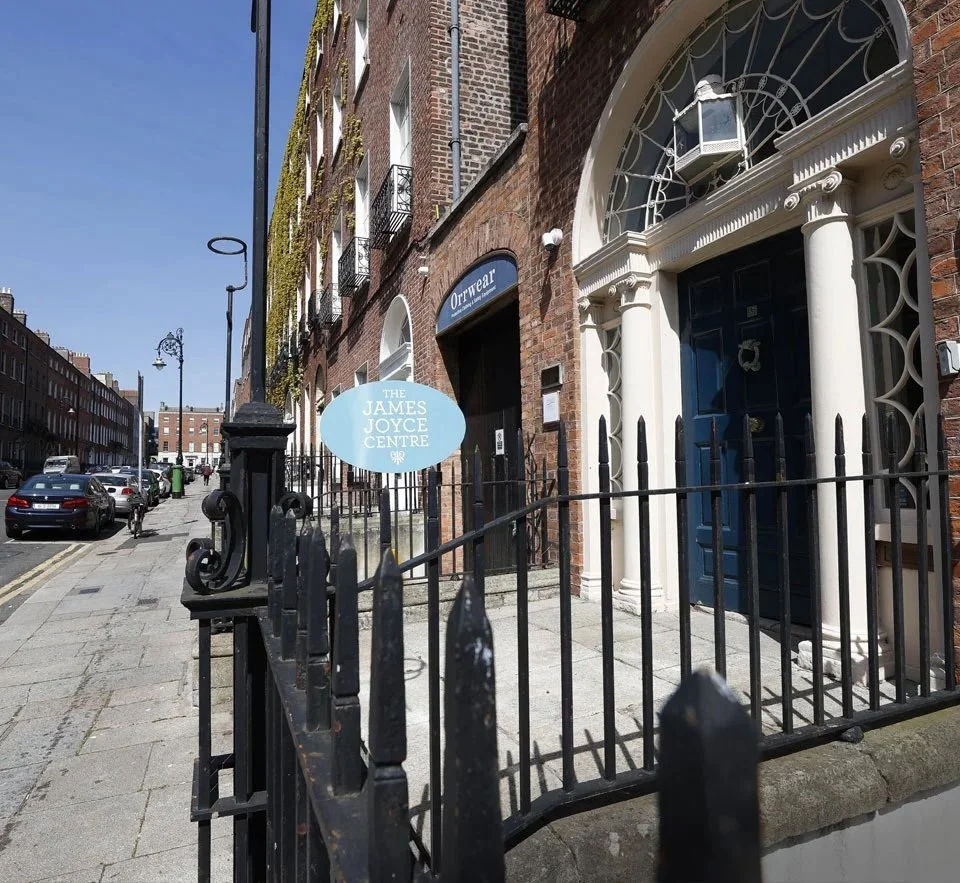
James Joyce Center, Dublin, Ireland.
DUBLIN*, MAY 25, 2026. As Josh our guide stands on the stoop of yet another building that plays a part in Joyce’s fiction, a gaunt grizzled Irishman elbows his way into our group and yells…
Wait, back up: Vicki and I are in Dublin, where I feel so at home I start talking like the Lucky Charms leprechaun, and Vicki knowing my fondness for Joyce buys me a ticket for “Introducing Joyce’s Dublin: A Literary Walking Tour.”
Obeying my iPhone, I exit the Shelbourne and stroll on a balmy morning across the Liffey via Connolly Bridge and arrive at the James Joyce Center, 35 North Great George’s Street. I peruse memorabilia including journals where Joyce published chunks of Ulysses and Work in Progress which became Finnegans Wake which even Joyce’s admirers found too much.
Josh our plump but not stately 35-ish guide in t-shirt and jeans calls us to him in the lobby at 11 am. He counts us, 11, good, all here. Once outside he asks where we’re from. A brother and two sisters, young, slim, good-looking, hail from Cork, gray-haired couple from San Francisco, girl with pink hair from Canada, another gray-haired couple from Morristown, New Jersey. I turn to them: I’m from Hoboken!
Josh is from Buffalo, New York, earned his PhD with a thesis on Joyce, he’s high strung, practically vibrating with all he wants to tell us about Joyce, Dublin, Ireland. But he’s curious about us, who’s read Dubliners? Almost all of us raise a hand. Portrait of the Artist? Again, most have read it. Ulysses? Fewer hands go up.
Finnegans Wake? Only I raise a hand. “Hard core!” Mr. Morristown says to me. Josh squints, perhaps disbelieving. “I read it for a course,” I explain, feeling like a pretentious dick. Or rather, I think the group thinks I’m a pretentious dick, which comes to the same thing.
We pause before Belvedere, a Jesuit school Joyce attended for five years. Joyce’s dad, John Stanilaus Joyce, couldn’t afford tuition but strolling through a nearby park ran into the priest who ran the school and talked him into giving James a free ride.
Joyce loathed the school’s hard-core Catholic indoctrination, Josh says, but the education was excellent, those Jesuits could teach, without his time at Belvedere Joyce wouldn’t have become Joyce, and if not for that chance encounter between Joyce’s dad and the priest we wouldn’t be standing here talking about Joyce.
Josh’s comment gets to me, it reminds me of the wonderful terrifying randomness of each individual life, of humanity, life in general, the entire universe. None of us should be here, odds are infinitely against our existence, there should be nothing but nothingness, but here we are. It’s weird if you think about it and if you don’t it’s still weird, objectively.
We linger before towering St. George’s church which looms in several of Joyce’s works. The church became a night club in the 1990s and now contains offices of some sort, haha typical of the secularization of Irish culture.
Here’s the hotel where Gabriel and his wife Greta end up after the party in Joyce’s “The Dead.” Ah yes, Gabriel thinks he’s going to get laid until Greta weepingly confesses she never stopped loving that dead boy. Then she falls asleep, leaving Gabriel bereft. Oh the poor human heart!
At the next stop Josh describes how precisely Joyce describes this street in Ulysses, and the gray-haired lady from San Francisco asks how Joyce got so many details of Dublin right considering he mostly wrote Ulysses in Trieste.
Good question, Josh says, Joyce had a phenomenal memory, maybe photographic, he also consulted maps and other references and wrote letters to friends back in Dublin who fact-checked for him.
It’s at this point while Josh is praising Joyce’s passion for accuracy that the gaunt madman jostles through our group, screams “Bullshit!” at Josh and moves on without breaking stride. Josh a tad rattled watches the man depart and says with a pained grin, “That was a Joycean moment.”
We reward Josh with a laugh, we feel good for him, it’s a fine line.
At another stop, Josh from memory cites the passage in which Leopold Bloom after a big breakfast of kidneys etc. empties his bowels. A man in our group snickers, a woman wrinkles her face and says “Gross,” Josh says yeah, you know the phrase “sacred and profane”? Well, Joyce loved mixing the sacred and profane.
Yeah, prissy Virginia Woolf thought there was too much pooping in Ulysses.
We continue to another building and again Josh stands on the stoop and tells us about the building’s link to Ulysses, but I’m distracted by the guy sitting on the next-door stoop with wild white beard and hair under a black broad-brimmed hat.
A minute or so into Josh’s spiel the man pulls big silver spoons from his coat and begins clacking the spoons against each other rhythmically and Josh is trying to ignore him when the spoon man gets up and pushes into our group and says he’s been persecuted and imprisoned twice for his spoon-playing by the Irish government but he will not be silenced. His face is red and mottled and his eyes pale blue and bulging, and he raves about how Irish officials are schizophrenic rapists and Josh listens with a grimace-smile and finally announces we have to go now and leads us down the sidewalk and the spoon man follows us halfway down the block screaming that god will punish us for being godless.
Mr. Morristown asks if this incident is part of the tour, haha, Josh shakes his head mournfully.
The two hours are up, we clap for Josh, who smiles bashfully, the group disperses. I walk with Josh two blocks back to the center. I ask how he ended up here. He says after he got his doctorate he couldn’t get a permanent university position, he was an adjunct at Trinity for a while then got this gig with the Joyce Center.
I ask if there’s still much scholarly interest in Finnegans Wake, given how hard it is, Josh says yeah, scholars still find it fascinating, devote their careers to it. I tell Josh about the Finnegans Wake seminar I took in college, the professor was a white-haired red-faced alcoholic gay Irish-American. Josh guesses the guy’s name, I can’t remember if that’s it.
What I don’t tell Josh is that I took the seminar in the aftermath of a drug trip that rocked me, left me in a semi-psychotic state for months, not so bad that I ranted at strangers in the street but pretty bad. So I was almost too receptive to the shape-shifting language of Finnegans Wake, immersion in the book further blurred the line between what was real and what a dream.
“Well, here we are,” Josh says, and I realize we’re back at the Joyce Center, and there leaning on the black spiky railing outside the center is Vicki with her red hair and scarf and lipstick.
As I approach, Vicki smiles and asks, “How was it?”
[*I started writing this column in Dublin, but I’m posting it in Belfast.]
A READER RESPONDS: John, You probably know about this club, but in case you don’t: The Marshall McLuhan "Finnegans Wake" Reading Club, a California-based book club founded by experimental filmmaker Gerry Fialka, spent 28 years reading James Joyce's famously complex novel.
The 28-Year Literary Journey
The Timeline: The group held its very first meeting in 1995 at a public library in Venice, California. They finally turned the 628th and final page in October 2023.
The Pace: Comprehending Joyce's dense, multilingual puns and dream-state prose required intense focus. The club started by dissecting two pages per monthly meeting but eventually slowed down to a grueling one page per month.
The Members: Over nearly three decades, the group fluctuated between 10 and 30 members. Some stayed for a few sessions, while others stuck around for decades, transitioning the meetings to Zoom during the COVID-19 pandemic to keep the tradition alive. [1, 2, 3, 4, 5, 6, 7]
Starting All Over Again
Because Finnegans Wake is entirely cyclical—ending mid-sentence with a fragment that loops perfectly back into the book's opening line—the club didn't look for a new novel when they finished. In November 2023, Fialka and the remaining members flipped right back to page one to start the book all over again. As Fialka famously told reporters, "There is no next book. We're only reading one book. Forever."
Further Reading:
My Bloomsday Tribute to James Joyce, Greatest Mind-Scientist Ever
The Dark Matter Inside Our Heads