

Arranged Marriages, Moonies and the Perils of Freedom
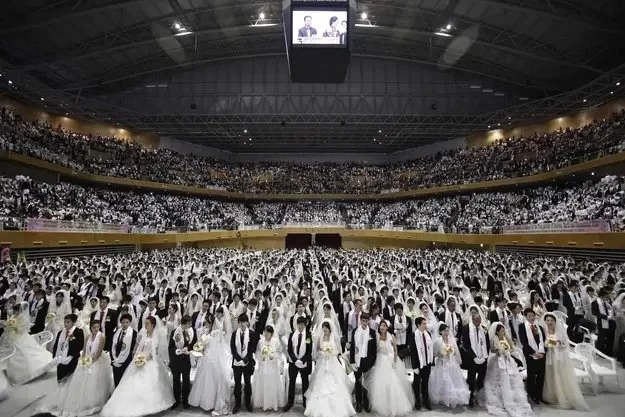
Mass Moonie wedding, Madison Square Garden, New York, 1982. I found this photo on Buzzfeed News.
JERSEY CITY, AUGUST 31, 2026. A grieving friend has me brooding over freedom’s downside. I’ll call him Zeke to preserve his privacy. We’ve known each other since childhood, and we have a lot in common.
Like me, Zeke was raised in a religious home in suburban Connecticut, rejected his parents’ faith at an early age, smoked weed, lusted after girls, went to college, hooked up with women, became a writer and college professor, got married, had two kids, got divorced, hooked up with more women. Pretty typical, right?
Several years ago, Zeke lost someone close to him. This tragedy left a gaping hole in his heart. it has forced him to second-guess his choices. He even wonders whether having lots of choices is a good thing.
Zeke dwells on a choice he made more than fifty years ago, when he was in his teens. His father met a man of the same faith with a daughter Zeke’s age. The two devout dads decided their kids might make a good match.
When his father pitched the match to Zeke, he immediately, mockingly, rejected it. Arranged marriage? Are you kidding? Zeke was an aspiring hippy, looking forward to free love.
Zeke now thinks his life might have been better if he’d agreed to the match and embraced his father’s religious values. Instead of pursuing the path of free love, Zeke should have committed himself to one woman, chosen by elders wiser than he.
And instead of being a freethinker, who seeks meaning in literary works that question life’s meaning, Zeke should have embraced his father’s ancient faith and scripture, which would have given Zeke the meaning he craved. If he’d done these things, he would have been happier—and averted the tragedy that tore his family apart.
My immediate impulse is to reject Zeke’s solution to life’s unpredictability and pain. Arranged marriage? Religion? Are you joking? But because my friend is suffering, I take his critique of modern secular freedom seriously, and several thoughts pop into my head:
A Moonie Marriage: When my marriage fell apart in 2009, I joined a men’s group. Six of us met once a month to talk about our troubles. We ended up griping about wives, ex-wives, girlfriends. We love women, but they can be such a pain yada yada.
One guy, a musician I’ll call Isaiah, never bad-mouthed his mate. He had been happily married almost 30 years, had five great kids. Oh sure, Isaiah and his wife had spats, she gave him a hard time for not being ambitious enough, but she loved him, he loved her.
Here’s what makes Isaiah’s story funny: When he and his wife met, they belonged to a religious community--some called it a cult--overseen by a South Korean preacher called Reverend Sun Myung Moon. Yeah, Isaiah and his wife were Moonies.
In 1982 Moon matched Isaiah with his wife and married them, along with more than 2,000 other couples, in a mass wedding in New York City’s Madison Square Garden. Isaiah and his wife eventually left Moon’s church. But their arranged marriage thrived—unlike the unions of me and others in the men’s group. Come on, that’s hilarious.
Houellebecq’s Joke: Zeke’s critique of modern, secular freedom also reminds me of French novelist Michel Houellebecq. His fictional narrators tend to be depressed, godless, promiscuous intellectuals who savagely mock feminism and other pillars of modern liberalism.
In Houellebecq’s bestseller Submission, a conservative Muslim becomes France’s President. He ends gender equality, allows men to have multiple wives, requires government employees to convert to Islam and so on. A dystopian nightmare, right? An Islamic version of The Handmaid’s Tale?
Not quite. Houellebecq’s joke is that modern French men and women are so exhausted by their secular freedom that they embrace conservative Muslim values. Deep down men dig being patriarchs, women dig being submissive. Supposedly. Haha, super funny.
Douthat’s Defense of Belief: Houellebecq’s depiction of religion’s joys is ironic. For an un-ironic, earnest defense of faith, check out Believe: Why Everyone Should Be Religious by Ross Douthat. Douthat, a Catholic, argues that religion can give us the meaning and solace we crave, and it’s quite compatible with science.
At least that’s what I think Douthat says, I haven’t read his book. But I’ve read many of his New York Times columns, and for the most part he’s a reasonable, undogmatic proselytizer. Plus, I agree with Douthat that science can’t explain our existence, which I’ve described as a “miracle.”
Here is how I summarize the position of Douthat, Houellebecq and my friend Zeke: Our modern secular way of life, which gives us so much freedom, is making us miserable. We would be better off giving up a little freedom in exchange for the comforts of religious faith.
I reject, respectfully, this position for two reasons: First, neither Catholicism—the religion of my childhood--nor any other monotheistic faith makes sense to me. I couldn’t accept any of these religions even if I wanted to, because I can’t believe in a benign, all-powerful god.
Second, all major faiths, to greater or lesser degrees, constrain our freedom, by telling us what to think, feel and do. To my mind, freedom is what gives life meaning. The more freedom we have to believe and behave as we choose, the better. That’s why I argue so passionately for free will, which I equate with freedom.
The expansion of freedom over the past few centuries—freedom to believe and be what we choose, freedom not just for white, straight, wealthy men but for everyone--has been humanity’s greatest accomplishment.
Sure, freedom comes with risks. Lacking religion’s guardrails, we might end up feeling lost and lonely, life might seem pointless. We might make choices we regret, like my friend Zeke. But that’s the price of freedom. If you’re not free to make mistakes, you’re not free.
Here’s what worries me: Some mistakes we make, communally, might be catastrophic and irreversible. We might choose not to avert the looming threat of climate change. We might choose to let artificial intelligences do our thinking for us. We might even freely choose to give away our freedom. That’s the catastrophe that most concerns me.
Imagine this Houellebecq-ish scenario: Voters in a modern democracy elect a former TV celebrity as President. This guy is a greedy, lying bully and sexual predator, but he’s adored by conservative Christians who think the modern secular experiment has gone too far. He turns out to be a tyrant who only gives a shit about the “rights” of those who pledge fealty to him. The once-thriving democracy devolves into a weird, dystopian blend of fascism, klepto-capitalism and fundamentalism.
Wouldn’t that be a hoot?
“ZEKE” RESPONDS:
This is Zeke.
Pithy important argument, especially your summary of Houellebecq’s book—spiritual exhaustion resulting from too much choice, and the mash-up with your Moonie friend. I don’t possess your intellectual acumen, but you seem to be equating choice and freedom. I’m not sure I agree. A few days after I met you, I had coffee with Carmen, a still-gorgeous, funny, lively, adorably-accented Puerto Rican lady with whom I had a super-fun, super sexy fling. Our little chat was great, mixing personal details (she raised two kids by different fathers) with her retirement plans (she bought a condo in PR). My imagination was in overdrive. She’s married, so I wasn’t going to try anything, but I enjoyed the electricity and hoped she’d give me a greenlight, even though I knew that would be wrong. Out loud, I remarked that in contrast to the early years of her marriage, her WhatsApp avatar was no longer her wedding photo, wondering if she’d split with her husband (whenever we texted—or the time we ran into each other—she complained about him). A day after our meetup, she switched her avatar to a photo of she and husband cavorting in beach-whites near the ocean. I think she enjoys being close to the flame without getting burnt. My big point is that during that encounter, and afterwards, I was her prisoner. I knew from past experience that despite her many pluses, I didn’t love her; worse, as she spoke about her grown kids, her financial challenges, her state of health (she’s in her 60s), her dislike of politics, I kept picturing her in the skimpy, indigo-colored lingerie she favored. I am also reminded of Norman Mailer’s “A Prisoner of Sex,” his screed against second wave feminism while espousing the “metaphysical nature of sex.” He also opposed birth control. (in the 80s, he got in my cab once, his arm protectively around his young son). Women, he wrote, are “nearer the creation of existence,” man’s “only connection to the future.” To paraphrase, we lack freedom because we don't choose our bodies, whom we desire, the intensity of desire, jealousy, sexual insecurity, possessiveness, rejection, love, pregnancy, aging, and mortality. They don’t disappear just because they are irrational. Sex is a metaphysical minefield. This led to a massive feminist backlash and the famous New York Town Hall debate, during which (you can watch it on YouTube) he and Germain Greer were clearly flirting.
Further Reading:
This column overlaps with so many others that you might as well just look at this list of “Cross-Check” columns. See also “A Pretty Good Utopia,” chapter nine of my book Mind-Body Problems.